Fit first. Rulebook second. Closure third.
Best weightlifting belts for fit, lift style and rules
Start with the belt shape your lifts and torso can accommodate. Rogue Oly Ohio is the tapered leather choice for Olympic lifting; 2POOD Ranch is easier to loosen during mixed sessions; Rogue Ohio is the traditional single-prong option; SBD 10mm is the dedicated powerlifting lever pick.
We checked current maker pages, specialist-store activity and the IWF and IPF rulebooks on . We did not wear, measure or lift in these belts. Fit and movement clearance still need a dry rehearsal on your body.
Avoid if: you expect a belt to diagnose, treat or prevent a physical problem. This guide covers dimensions, rules, materials and fitting actions only.
Verify before buying: measure where the maker says the belt will sit, then confirm the exact event rulebook if you compete.
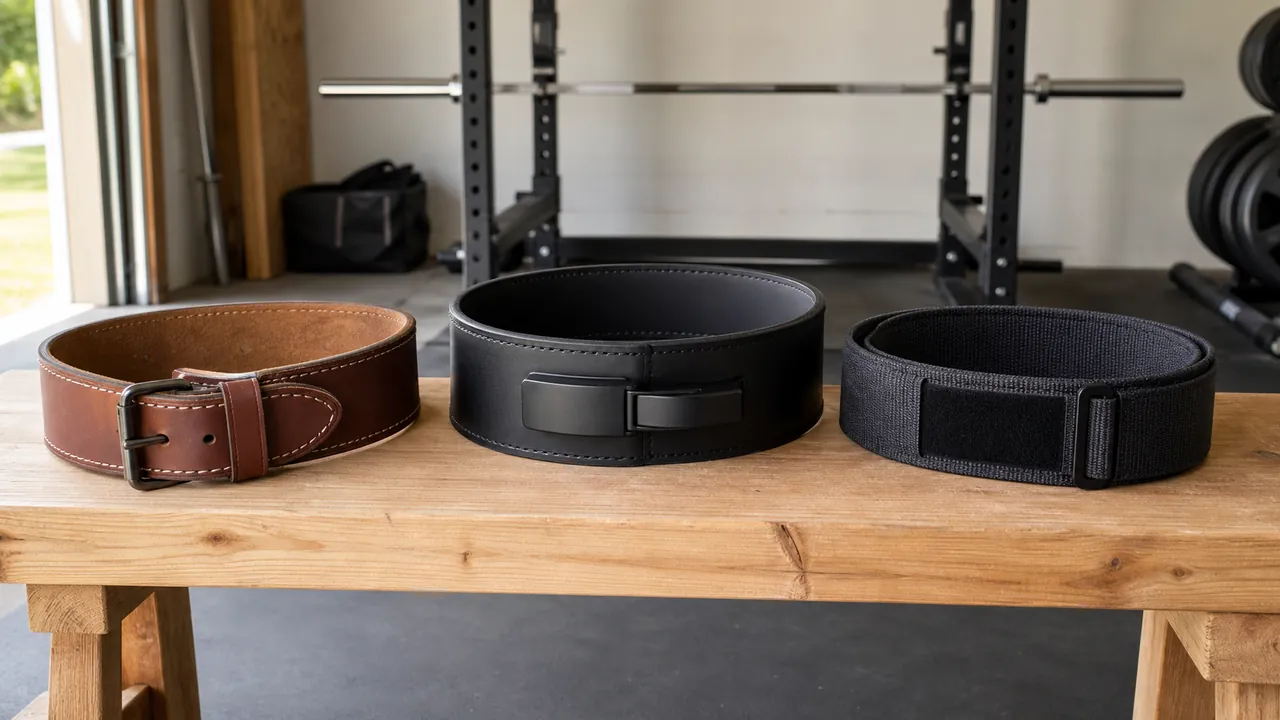
Choose the job before the thickness
“Weightlifting belt” is used for several different pieces of equipment. The receiving position of a clean, the braced setup for a squat and a mixed conditioning session do not place the same demands on belt width or closure.
Olympic lifts
Begin with a tapered front and sides if a straight belt crowds the ribs, hips or bar path. Ten millimetres of leather is still substantial, so the taper is a clearance feature, not proof of comfort.
Mixed sessions
A textile belt can be loosened without fully unthreading a prong. That helps when lifting sets alternate with bodyweight or conditioning work. Hook-and-loop is also a wear surface, so inspect it rather than treating it as permanent.
General barbell training
A single-prong leather belt is mechanically simple and offers multiple holes. The central question is whether a uniform four-inch body fits between your lower ribs and hip crest in the movements you actually train.
Powerlifting meets
Use the current federation rulebook and approved-equipment list. A legal maximum is not a fit recommendation, and an approval badge on one model or federation does not automatically carry into another event.
Read the belt before reading the marketing
These terms change what arrives, how it adjusts and whether it belongs in your training or meet bag. Read them before comparing price, because a cheaper wrong shape is still the more expensive purchase after return shipping or an unusable meet-day check.
Uniform width
Meaning: the belt body stays the same width around most or all of the torso.
Why it matters: a four-inch straight belt occupies about 10.2 centimetres from ribs toward hips everywhere.
Check: compare that width with your usable torso space while standing, hinging and squatting.
Do not assume: more contact area automatically means a better fit.
Taper
Meaning: the belt narrows at the front or sides while keeping a wider rear panel.
Why it matters: less front bulk may reduce interference in deep receiving or hinge positions.
Check: note exactly where the wide-to-narrow transition sits on your body.
Do not assume: every belt called “Olympic” uses the same taper or thickness.
Thickness
Meaning: the depth of the belt material, commonly stated in millimetres for leather belts.
Why it matters: thicker leather generally bends less readily, but hide, layers and construction also matter.
Check: try the exact thickness rather than inferring feel from a number.
Do not assume: 13 mm is an upgrade from 10 mm for every lift or torso.
Single-prong closure
Meaning: one metal tongue enters one of several punched holes.
Why it matters: hole spacing determines adjustment increments and the tail must pass through the buckle.
Check: make sure your normal setting is near the middle of the hole range, not the last hole.
Do not assume: two prongs create a better fit; they mainly change the fastening process.
Lever closure
Meaning: a mounted mechanism closes the belt at a preset circumference.
Why it matters: closing and opening are quick, but conventional levers need tools to move far between settings.
Check: learn how the exact lever adjusts and whether the setting range covers clothing and bodyweight changes.
Do not assume: every lever is fixed; SBD's gliding lever permits adjustment within its mechanism.
Hook-and-loop with clamp
Meaning: a textile strap fastens onto itself and passes through a secondary locking buckle.
Why it matters: it can loosen quickly, while the fabric and hook surface experience normal wear.
Check: inspect stitching, hook engagement and the clamp before each use.
Do not assume: a “lifetime” defect warranty covers expected deterioration of the closure.
Approved equipment
Meaning: a governing body has accepted an exact model under a defined equipment program.
Why it matters: some powerlifting meets restrict brands and models beyond dimensional rules.
Check: match brand, exact model, federation, meet and rulebook date.
Do not assume: “competition approved” is universal or permanent.
Compare geometry before closure
The table is a routing tool, not a performance ranking. Use the first column that matches your training, then test body clearance and read the current size chart.
| Model | Best-fit lane | Body geometry | Closure | Current activity signal | Primary caution |
|---|---|---|---|---|---|
| Rogue Oly Ohio | Olympic-lift leather | 4 in rear, 2 in front/sides; 10 mm | Single prong | 99 maker-page reviews | Still a thick leather belt |
| 2POOD Ranch Straight | Mixed lifting and conditioning | 4 in straight textile body | Hook-and-loop plus WODClamp | 3,302 exact-page reviews | Closure wear and warranty wording |
| Rogue Ohio | Traditional general strength | 4 in straight; 10 mm +/- 1 mm | Single prong | 486 maker-page reviews | Uniform width may crowd short torsos |
| SBD 10mm Lever | Powerlifting rule lane | 10 cm straight; 10 mm | Gliding lever | Current regional direct sale and IPF-approved identity | Cost and torso clearance |
Hold a belt appointment before removing the tags
A standing mirror check misses the positions where a belt can crowd the body or hardware can catch. Keep the belt clean, follow the seller's return conditions and perform this unloaded sequence over the clothes you normally wear.
- Measure the maker's location. Use the stated position, commonly around or just above the navel, while bracing as directed. Do not submit trouser size.
- Check range, not just inclusion. Choose a size that puts your likely setting away from the first and last usable hole or adjustment edge. Account for clothing and plausible bodyweight change.
- Stand and breathe normally. The belt should stay in the intended location without hardware pressing a single point. This is a fit observation, not a medical test.
- Hinge with an empty bar position. Note whether the front width, buckle or lever contacts the upper thigh or pulls the belt out of position.
- Squat to your training depth without load. Check lower-rib and hip-crest contact on both sides. A belt edge that merely exists is different from one that blocks your position.
- Weightlifters rehearse receiving positions. Use a dowel for clean and snatch receiving depth and check the buckle against the bar path. Never use a loaded lift as the first fit test.
- Practice opening it. A prong that cannot be released calmly or a clamp that is barely engaged is a reason to revisit size and setup before training.
Reject the fit when: the intended setting sits at the adjustment limit, the wide section cannot clear ribs and hips through your normal range, the hardware obstructs a movement, or the exact belt violates your event rules.
Repeat the sequence at every position you intend to use. Some lifters place a belt differently for a squat and a deadlift, but that does not mean one size automatically covers both. Record the hole, lever position or overlap for each movement. If one setup moves the buckle into the thigh or leaves too little closure engagement, treat that as a different fit problem. The useful result is a repeatable position that stays within the maker's adjustment instructions, not the tightest setting you can force.
Four belts for four different constraints
Rogue Oly Ohio Lifting Belt
Choose this when you want traditional 10 mm leather but need less width at the front and sides than a uniform power belt.
- The maker states a four-inch rear that tapers to two inches at the front and sides.
- Single-prong hardware, buckle guard and exact Ohio manufacture are documented.
Tradeoff: taper does not make 10 mm leather light or universally comfortable.
Avoid if: you need quick loosening throughout mixed conditioning or cannot try thick leather before the return window.
Alternative: 2POOD Ranch for a textile closure; Rogue Ohio if you prefer uniform width.
Verify: measure at the maker's location and rehearse the clean receiving position with a dowel.
2POOD Ranch 4-inch Straight Belt
The hook-and-loop strap and WODClamp make this the practical lane for sessions where the belt is loosened between barbell and conditioning movements.
- XXXS through XXL gives a broader small-size run than the leather shortlist.
- The exact direct page was orderable and displayed 3,302 owner reviews.
Tradeoff: hook-and-loop deterioration is normal wear under the current warranty block, and another 2POOD page gives inconsistent warranty duration language.
Avoid if: you want a leather prong or lever, or your event does not accept the exact model.
Alternative: Rogue Oly Ohio for tapered leather.
Verify: ask 2POOD to confirm the applicable warranty in writing and inspect full clamp engagement.
Rogue Ohio Lifting Belt
This is the straightforward leather choice when a uniform four-inch body fits your torso and you prefer holes over a lever mechanism.
- Rogue states 10 mm +/- 1 mm vegetable-tanned USA leather and Ohio manufacture.
- The current exact page carried 486 reviews, the strongest Rogue exact-model signal in this shortlist.
Tradeoff: every part of the body is four inches wide, and Rogue does not publish a belt-specific warranty duration.
Avoid if: four inches touches both lower ribs and hip crest in your squat or hinge.
Alternative: Rogue Oly Ohio for a two-inch front and sides.
Verify: land near the middle of the hole range and ask Rogue which written warranty class applies.
SBD 10mm Lever Belt
Select the exact 10 mm edition when powerlifting rules, a low-profile lever and a current approved-equipment identity are the purchase constraints.
- Its 10 cm width and 10 mm thickness sit within the current IPF dimensional maximums.
- SBD states British cowhide and manufacture in Sheffield, with sizes XS through 5XL.
Tradeoff: it is expensive, straight-bodied and still requires exact meet verification despite the approval label.
Avoid if: you are shopping primarily for Olympic weightlifting, frequent fast loosening or a narrow torso without an in-person fit check.
Alternative: Rogue Ohio for a prong; 2POOD Ranch for mixed sessions.
Verify: match the exact edition to the federation's current approved list and preserve return condition during the fit rehearsal.
Build a rulebook passport for the exact belt
Save one note with six fields: federation, event, rulebook version and effective date, exact belt model, dimensional limits, and whether an approved-equipment list applies. Add the organizer's written answer when anything is unclear. Take the note to equipment check rather than relying on a retailer badge remembered from checkout.
IWF weightlifting
The November 2025 IWF rules allow a belt outside the costume and set a maximum width of 12 cm. They do not tell you that the widest legal belt fits your receiving position.
IPF powerlifting
The rulebook effective 1 March 2026 sets a maximum width of 10 cm and thickness of 13 mm, alongside its approved-equipment system. Other federations can differ.
Named mistake prevented: buying “competition approved” without recording which competition. Rules and lists can change between purchase and meet day.
Width, construction, origin and support records
These are due-diligence facts, not a second ranking. Overall length and assembled weight were not consistently published, so the table keeps those gaps visible.
| Product | Size and weight | Materials | Manufacturing origin | Brand | Warranty/support |
|---|---|---|---|---|---|
| Rogue Oly Ohio Lifting Belt | 10 mm; 4 in rear to 2 in front/sides; S-2XL; weight not disclosed | Vegetable-tanned USA leather, reinforced stitching, single-prong roller buckle and guard | Made in Ohio, USA from USA leather | Rogue Fitness; Columbus, Ohio; founded 2006; strength equipment | Rogue gives no belt-specific duration; general defect claims are reviewed under its policy |
| 2POOD Ranch 4-inch Straight Belt | 4 in wide; XXXS-XXL; overall dimensions and weight not disclosed | Woven textile body, hook-and-loop strap and WODClamp; full fibre stack not disclosed | Not disclosed by manufacturer for this exact model | 2POOD; North Carolina contact region; established 2010; weightlifting and functional-fitness accessories | Current block says lifetime manufacturing-defect cover for hook-and-loop belts but excludes normal wear; older wording conflicts |
| Rogue Ohio Lifting Belt | 10 mm +/- 1 mm; 4 in wide; S-2XL; weight not disclosed | Vegetable-tanned USA leather with single-prong roller buckle and stitching | Made in Ohio, USA from USA leather | Rogue Fitness; Columbus, Ohio; founded 2006; strength equipment | Rogue gives no belt-specific duration; confirm coverage and exclusions directly |
| SBD 10mm Lever Belt | 10 mm thick; 10 cm wide; XS-5XL; weight not disclosed | Two cuts of British cowhide, black oiled leather exterior, red suede interior, gliding lever | Made in Sheffield, Great Britain from British cowhide | SBD Apparel; Sheffield, Great Britain; founded 2013; powerlifting apparel and approved equipment | The checked page gives no model-specific duration; verify regional warranty and unused-return terms |
Care for the closure you bought
- Follow the maker's leather-care instructions; SBD specifically recommends periodic black shoe polish on its outer leather and warns against dropping the buckle.
- Keep hook-and-loop surfaces clear of lint and inspect stitching and clamp engagement. Normal surface deterioration is not the same as a manufacturing defect.
- Check prong, holes, rivets, lever fasteners and belt edges before use. Ask the maker for replacement or retirement instructions when hardware loosens or material separates.
- Do not drill holes, relocate a lever or modify the body before checking both maker instructions and competition rules.
- Recheck size charts, model identity, return conditions and rulebook dates immediately before purchase.
How this shortlist was separated
We mapped direct specialist stores and governing rules before choosing products. Included belts needed a normal same-day purchase path, exact identity, enough construction data to explain fit, and a concrete popularity or competition-visibility signal. Popularity did not decide the winner: it only helped show that the model remains active enough to investigate.
Products were removed when they duplicated a lane, appeared only as final-sale remnants, lacked a stable model identity or required medical or performance claims to sound compelling. We did not compare price because it moves by region and date. We also did not rank comfort, support, durability, injury outcomes or added weight on the bar, because this project has no controlled wear or lifting evidence.
Product pages and rulebooks checked
- Rogue Oly Ohio Lifting Belt
- Rogue Ohio Lifting Belt
- Rogue lifting-belt category
- Rogue warranty policy
- 2POOD Ranch Straight Belt
- 2POOD belt guide
- 2POOD warranty block
- SBD 10mm Lever Belt
- SBD approved-equipment page
- IWF 2025 technical rules
- IPF rules effective March 2026
- IWF equipment explainer
Found a changed specification or rule? Contact Garage Gym Power.