Room-first equipment guide
Best All-in-One Home Gyms for Real Rooms
Four current systems, separated by how they load, what else they require, and whether your room can actually use every station.
We checked current manufacturer specifications, manuals, regional ordering paths, and warranty pages. We did not assemble or train on these machines, so pulley feel, noise, stability, user fit, and assembly quality still need a showroom or return-window check.
Researched for home strength trainees and households planning one permanent station.
Start with the resistance workflow, not the exercise count. Choose the Force USA G3 if you accept moving plates to keep the entry cost down; the Force USA G12 for quick 1:1 stack changes plus rack and Smith stations; the REP Ares 2.0 if you want a configurable REP rack ecosystem; or the Centr 3 for guided, pin-selected training without a free-bar rack.
Do not buy yet if: you have only checked the assembled footprint. Smith sleeves, cable travel, bench pull-out, pull-up headroom, plate access, and maintenance space can exceed it.
Verify before paying: the exact regional warranty, curbside freight plan, package dimensions, anchoring requirement, ceiling procedure, and every component needed for a usable system.
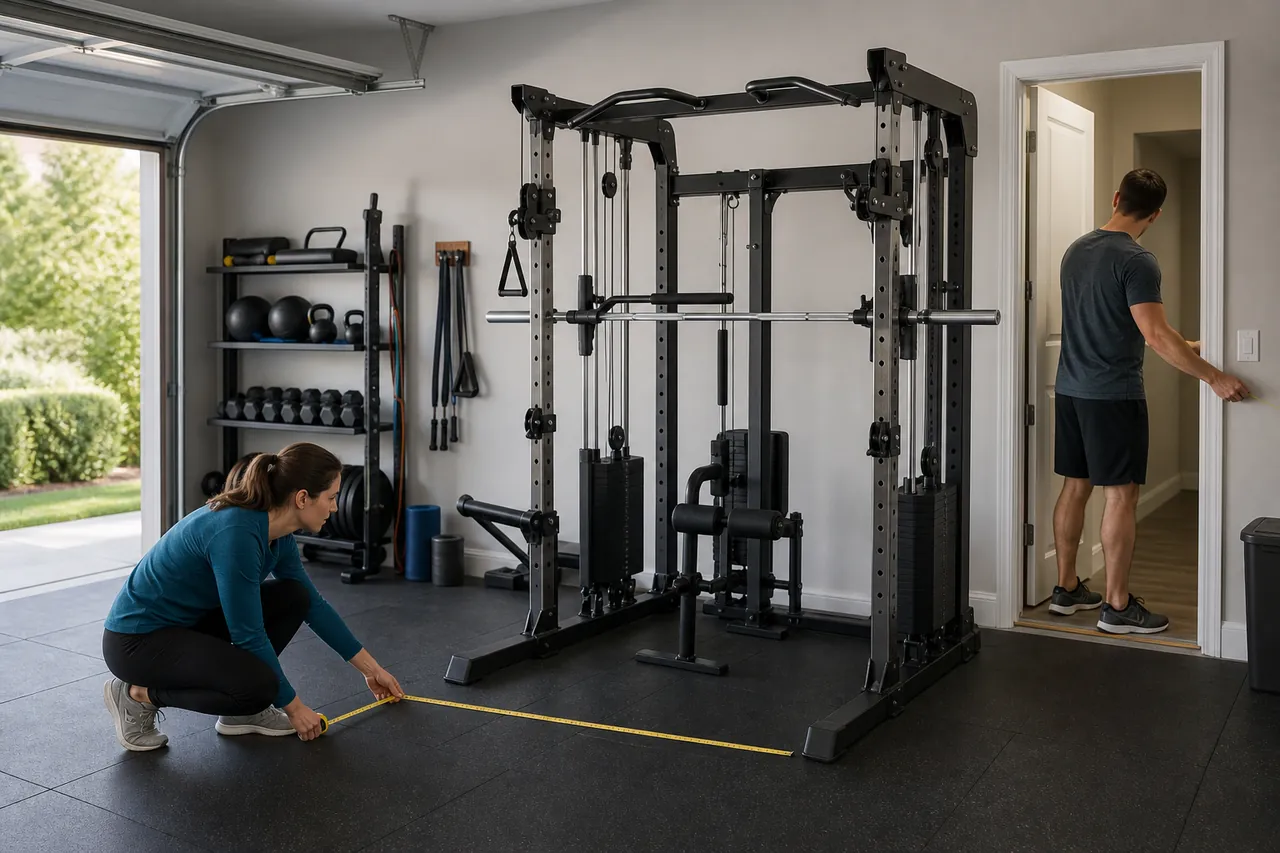
Go to the four-system comparisonHeader image is AI-generated and illustrative; it does not show a recommended model or a product test.
An all-in-one machine saves floor area only when its stations share space without blocking one another. A rack, Smith bar, and cable pair can occupy one frame yet require a clear aisle on both sides for plates, a long runway for cable work, and enough depth to roll an adjustable bench in and out. A compact frame in a product photo can therefore demand a surprisingly large room.
This guide compares products that solve different versions of the same problem. The G3 and G12 are rack-shaped systems with Smith, cable, and free-bar stations. Ares 2.0 is an attachment selected with a compatible REP rack, so its finished dimensions and cost depend on the builder. Centr 3 is a guided Smith-and-cable system, not a free-bar power rack. Keeping those boundaries visible is more useful than declaring one universal winner.
Read the specifications correctly
Read the room before reading stack numbers
Movement envelope
The complete space used by the frame, moving bar, cables, bench, plates, your body, and service access.
A machine can fit on the floor and still lose a station against a wall.
Tape the frame, then separately mark each moving zone at full reach.
Assembled dimensions describe the machine, not every exercise around it.
Cable ratio
A 2:1 path moves twice as much cable for a given stack movement and usually presents roughly half the selected stack at one handle; 1:1 presents approximately the selected load.
It changes travel, weight increments, and what the stack label means at the hand.
Compare usable handle resistance and travel, not stack size alone.
A bigger stack on a 2:1 system is not automatically heavier at one handle than a smaller 1:1 stack.
Selectorized
Resistance changes by moving a pin in a built-in weight stack.
Shared users can change loads quickly without carrying plates across the room.
Check the smallest increment, top usable resistance, and whether two sides have independent stacks.
Pin-loaded does not mean the Smith station is stack-connected; read each product's routing.
Plate-loaded cable
Olympic plates are placed on a carriage that supplies cable resistance.
It can lower machine cost, but every change takes handling and plate storage.
Include the plates you need and clearance to load them in the complete-system plan.
“Plates sold separately” can turn an attractive base price into an incomplete gym.
Smith station
A bar travels on fixed vertical guides and catches on built-in stops or hooks.
It supports guided bar work but follows a path different from a free bar.
Check bar starting weight, sleeve width, stop positions, and whether your bench lines up.
A Smith station does not replace a free-bar rack for every lifter or movement.
Rack attachment
A cable system that depends on a specified rack family, height, depth, post count, and stabilizing parts.
The attachment price and dimensions are not the complete system.
Export the final builder list and match every rack generation and required foot.
Matching post size alone does not prove cross-brand or cross-generation compatibility.
Curbside freight
A carrier delivers a pallet to the accessible edge of the property rather than carrying boxes into the gym.
Some systems arrive in several heavy crates and require inspection, staging, and help.
Ask for package count and weights, clear the path, arrange people or equipment, and photograph damage before signing.
Paid shipping does not necessarily include threshold, room-of-choice, or assembly service.
Assembly clearance
The height and turning room needed to raise uprights, crossmembers, and pull-up bars during the build.
A finished machine can fit under a ceiling even when the longest subassembly cannot be tilted into place.
Read the assembly sequence, measure the tallest loose part, and mark ducts, lights, doors, and the turning path.
The final assembled height does not prove the machine can be built in that room.
How the shortlist was built
We split complete gyms from build-your-own systems
We mapped manufacturer-direct and specialist ordering in the US and UK/EU, then removed machines with stale identity or weak current support. The Body-Solid G6BR, for example, was excluded because its manufacturer path labels it discontinued even though residual stock controls remain visible elsewhere.
Each included model needed a current exact-product ordering or configuration surface, a distinct buyer lane, an observable market signal, a meaningful drawback, and enough official detail to check fit and ownership. Manufacturer popularity labels and review counts helped confirm that buyers can realistically encounter a model; they did not prove performance.
Shortlist at a glance
What each station includes and still needs
The “complete it with” column prevents a base machine or attachment from being mistaken for a ready-to-train setup.
| System | Resistance workflow | Published frame or added size | Complete it with | Best fit |
|---|---|---|---|---|
| Force USA G3 | Plate-loaded 2:1 cables; 35 lb guided Smith bar; free-bar rack | About 75.6 W x 60.6 D x 86.6 H in at Smith bar | Olympic plates, barbell, bench; lane-specific attachments | Plate owner prioritizing integrated function per purchase dollar |
| Force USA G12 | Two 220 lb stacks; 1:1 cables; plate-loaded Smith and free-bar rack | About 79 W x 49 D x 88 H in; more ceiling needed for pull-ups and assembly | Bench, barbell, plates, an executable freight/assembly plan | Household wanting fast cable changes and heavier direct stack resistance |
| REP Ares 2.0 | Rack-integrated 2:1 trolleys plus center lat/low-row routing | Adds 5.2 in width and 6 in depth; total depends on rack build | Compatible rack, required feet/posts, J-cups, bench, bar and plates | Buyer who wants to configure and extend one rack ecosystem |
| Centr 3 | Two 165 lb stacks and stack-connected selectorized Smith | 59 W x 46 D x 84 H in; about 89 W x 52 D usable area advised | Bench and selected handles; written warranty confirmation | Shared home that values pin changes over free-bar rack work |
Recommendations by constraint
Match the resistance path to the household
For the plate owner who accepts slower changeovers
Force USA G3 All-In-One Trainer
The G3 is the sensible entry to a rack, Smith, and adjustable-cable frame when you already own Olympic plates or want to buy them once for every station. Its 2:1 cable path favors longer travel and smaller effective jumps. The current V2 is sold through Force USA in the US and across regional UK/EU stores.
It consolidates the major stations without making you pay for two built-in stacks. The base frame also keeps free-bar work available.
Plates must move between cable carriage, Smith work, and free bar. Supersets can become equipment changes, and side loading needs room.
Avoid if: another household member needs quick pin changes, plate handling is a barrier, or a 2:1 cable’s effective top resistance is too low for your intended movement.
Closest alternative: Centr 3 removes loose-plate changes; G12 preserves the rack class with built-in stacks.
What to verify: current regional bundle, V2 attachment compatibility, floor anchoring guidance, and the usable cable load with your plate inventory.
For fast stack changes without giving up rack stations
Force USA G12 All-In-One Trainer
The G12 combines dual 220 lb stacks at 1:1 with Smith and free-bar stations. That makes the selected stack closer to the resistance read at the handle and lets two cable stations remain set independently. It suits a shared room where changeover friction matters enough to justify a much heavier permanent system.
Pin-selected 1:1 stacks support quick transitions and straightforward load reading while the frame still handles barbell and Smith work.
The manufacturer describes roughly 1,213 lb of shipped pallet/crate mass. Curbside handling, assembly sequence, and future moving are part of the purchase.
Avoid if: your ceiling is merely equal to the 88-inch frame, the delivery route has stairs or tight turns without a staging plan, or you expect to relocate soon.
Closest alternative: G3 sheds integrated-stack mass and cost; REP Ares 2.0 gives more rack-configuration control.
What to verify: Force USA recommends 93 inches for full pull-ups and flags a 110-inch assembly issue for counterbalance insertion. Confirm the current manual and installer’s sequence for your ceiling.
For a rack ecosystem you intend to configure, not just receive
REP Ares 2.0 Cable Attachment
Ares 2.0 is the strongest fit here for a buyer who treats the rack as a long-term platform. It integrates adjustable trolleys, lat pulldown, and low row into compatible PR-4000 or PR-5000 builds, and REP maintains builders in the US, UK, and EU. Its official added dimensions are useful, but they are only additions to the selected rack.
You choose rack height, depth, post count, and accessories instead of accepting a fixed all-in-one frame. The cable system shares the rack footprint.
Compatibility is exacting. Rack family, generation, depth, posts, and front feet can change what works. A cart with only “Ares 2.0” is not a gym.
Avoid if: you want one SKU, one published assembled weight, or freedom to mix unverified third-party rack parts without warranty consequences.
Closest alternative: G12 arrives as a defined rack/Smith/cable system; G3 is the simpler plate-loaded route.
What to verify: export the complete builder, check mini-foot requirements, match cable travel to rack height, and save the warranty that applies in your region.
For guided training and low-friction load changes
Centr 3 Home Gym
Centr 3 pairs two 165 lb pin stacks with adjustable cables and a stack-connected selectorized Smith bar. It is the easiest shortlist option to understand as a shared guided system: no free bar, no separate plate pile, and fewer parts to coordinate between users. The manufacturer’s support page also gives a useful 89-by-52-inch working-area target rather than only the 59-by-46-inch frame.
Pin changes are quick, the 631 lb system is materially lighter than the heaviest stack/rack combinations, and the usable-area guidance makes room planning clearer.
It does not provide a free-bar power rack, and current official warranty wording conflicts between the product page and newer support articles.
Avoid if: barbell squats inside a rated rack are central to your plan, or the seller will not put the applicable frame, parts, labor, and shipping coverage in writing.
Closest alternative: Inspire M3 is a narrower conventional multi-gym; G12 adds a free-bar rack and independent 1:1 stacks at much greater mass.
What to verify: ceiling over 96 inches, fixed-stack sufficiency, Smith resistance behavior, and the exact warranty supplied by your seller.
Due diligence after fit
Dimensions, steel, origin, and support on record
Brand location is not manufacturing origin. None of the checked official sources stated where these exact models are made, so that field remains explicit rather than guessed.
| Product | Size and weight | Construction | Exact-model origin | Brand background | Warranty/support |
|---|---|---|---|---|---|
| Force USA G3 All-In-One Trainer | About 75.6 W x 60.6 D x 86.6 H in; 184 kg / 406 lb V2 specification. | Powder-coated heavy-gauge steel; plate carriage, 2:1 cables, guided Smith bar. | Not disclosed by the manufacturer for this exact model in sources checked. | Force USA, established 2008; US operating base in Utah with regional UK/EU stores; known for racks and integrated trainers. | US home policy lists lifetime frame, 10 years moving parts, and 1 year upholstery/attachments. Original purchaser, use, maintenance, freight, and regional limits apply. |
| Force USA G12 All-In-One Trainer | About 79 W x 49 D x 88 H in. Exact assembled weight not clearly published; approximate shipment is 1,213 lb including crates, pallet, and packing. | Steel rack and Smith structure; dual 220 lb stacks; 1:1 nylon-coated cable system. | Not disclosed by the manufacturer for this exact model in sources checked. | Force USA, established 2008; US operating base in Utah; all-in-one trainer and rack specialist. | Same current US home policy: lifetime frame, 10 years moving parts, 1 year upholstery/attachments. Confirm regional seller terms. |
| REP Ares 2.0 Cable Attachment | Adds 5.2 in width and 6 in depth; total heights 82.1 or 93.9 in by rack. Weight and total footprint depend on configuration. | Steel rack attachment with dual stacks, adjustable 2:1 trolleys, and central lat/low-row routing. | Not disclosed by the manufacturer for this exact attachment in sources checked. | REP Fitness, founded 2012 in Colorado; designs modular racks, benches, and cable integrations with US, UK, and EU operations. | Frames and structural welds have lifetime coverage for the original purchaser; pop-pins, pulleys, bearings, and cables are 1 year. Modification and storage exclusions apply. |
| Centr 3 Home Gym | 59 W x 46 D x 84 H in; 631 lb / 286 kg. Support recommends about 89 W x 52 D in usable area. | Powder-coated heavy-duty steel, industrial-grade cables, two 165 lb stacks, and 20 lb selectorized Smith bar. | Not disclosed by the manufacturer for this exact model in sources checked. | Centr, established 2005 as a digital wellness brand; now sells home equipment including Inspire-designed strength systems from US operations. | Conflicting official copy: product page says limited lifetime, newer support says 1-year residential parts coverage. Obtain the exact seller warranty in writing. |
Do this in the room
Tape every bar, cable, bench, and plate path
Enter your clear room dimensions for a first screen, then perform the taped rehearsal below. The tool deliberately does not declare a product “safe”; it only exposes obvious dimension conflicts.
Frame
Tape the published width and depth. Mark uprights, rear stacks, feet, and every selector-pin side.
Moving metal
Add full Smith-sleeve width, plate diameter and hand access, safety arms, and doors that swing into the zone.
Cable arc
Stand at the end position of fly, row, and lateral work. Hold a rope or tape from each trolley without pulling furniture into the path.
Bench and body
Roll the real bench from flat press to incline and row positions. Rehearse pull-up headroom with the intended grip, without jumping or loading equipment.
Before the carrier calls
Plan the pallet from curb to final bolt
This one-page record prevents a curbside pallet from becoming an improvised moving job.
Seller, package count, heaviest package, longest piece, pallet dimensions, delivery service level, appointment contact.
Driveway grade, threshold, narrowest door, stair count, tightest turn, ceiling pinch point, dry staging area.
Named helpers, lifting aid, socket sizes, torque tool, step platform, floor protection, installer responsibility.
Photograph pallet and labels, count packages, note damage before signing, keep packaging until every station is assembled and checked.
For the G12, add the manufacturer’s ceiling-sensitive counterbalance step. For Ares 2.0, print the builder bill and check every post, crossmember, foot, and hardware carton against it. For all systems, decide where hundreds of pounds of components will wait without blocking an exit.
Price the usable gym
Price the plates, bench, flooring, and rack parts
Training parts
Bench, barbell, plates, collars, handles, ankle strap, lat bar, low-row footplate, spotter arms, storage.
Room parts
Flooring, shims if permitted, wall clearance, lighting relocation, mirror protection, dehumidification compatible with warranty terms.
Arrival parts
Freight surcharge, room-of-choice option, assembly, disposal, helper hire, tools, packaging storage.
Ownership parts
Replacement cables and wear pieces, inspection schedule, lubrication specified by the manual, moving or disassembly cost.
Enter current local quotes rather than reusing a published price. The meaningful comparison is complete system versus complete system, with tax and freight on the same basis.
Disqualifiers first
The exercises and households these systems miss
One failure can affect several stations
A damaged cable, trolley, guide, or central frame can interrupt more of the gym than a standalone machine failure. Ask how wear parts are identified and shipped in your region.
Two people may still collide
Dual stacks do not guarantee two-user training. Bench position, shared pull-up area, plate sleeves, and cable crossings can block simultaneous use.
Garage location can change coverage
“Home use” and “indoor use” are not interchangeable in every warranty. Ask whether an unconditioned garage, humidity, temperature swing, or outdoor-adjacent storage changes coverage.
A guided bar remains guided
A Smith path can be useful, but it does not make the frame a free-bar rack. Choose G3, G12, or an appropriate REP rack build if rated free-bar work is a requirement.
Final call before payment
Get these five answers in writing
- The exact generation: model code, current manual, included attachments, and any old/new accessory incompatibility.
- The final configuration: every component required for cable routing, stability, spotting, and the movements you actually plan.
- The delivery record: package count and dimensions, heaviest unit, curbside versus threshold terms, damage procedure, and installer scope.
- The written warranty: region, residential location, frame, cables, pulleys, bearings, labor, freight, transfer, and required maintenance.
- A live fit demonstration: your bench at intended angles, shortest and tallest user on cable settings, pull-up position, and the heaviest planned cable movement. Treat comfort, stability, noise, and smoothness as observations, not assumptions from steel thickness.
Buy only after one product passes all three records: movement envelope, complete-system bill, and freight passport. If none passes, separate rack and cable stations may use the room better even when their catalog footprint looks larger.
Primary references
Manufacturer pages, manuals, and regional terms
Specifications and policies can change. Open the regional version that will govern your order.
- Force USA G3 product page
- Force USA all-in-one comparison
- Force USA UK all-in-one store
- Force USA G3 V2 manual
- Force USA G12 product page
- Force USA G12 ceiling guidance
- Force USA warranty policy
- REP Ares 2.0 US builder
- REP Ares 2.0 Europe builder and specifications
- REP warranty policy
- REP company history
- Centr 3 product page
- Centr equipment warranty support
- Centr 3 room and equipment FAQ
- Inspire M3 alternative specifications
Brand names identify products editorially. No rating, price, or seller claim was treated as hands-on proof. The header is AI-generated. For factual corrections, send Garage Gym Power the exact model, source, region, and date.