Cable geometry before stack size
Best Cable Crossover Machines for Home Gyms
Four current ways to buy two adjustable cables, separated by travel, usable resistance, room width, and loading workflow.
We checked exact manufacturer pages, manuals, regional stores, dimensions, pulley ratios, ordering controls, and written warranties. We did not assemble or train on these machines, so cable feel, trolley play, noise, stability, and user fit need an in-person or return-window check.
Researched for home-gym buyers comparing standalone trainers with one rack-dependent attachment.
Choose the REP Arcadia when depth and cable travel matter most; the Bells of Steel Functional Trainer when you want to choose stack or plates; the Powerline PFT100 for a published 52-inch pulley span and established parts route; or the MyRack Cable Crossover only when a compatible rack is already part of the plan.
Do not buy yet if: you are comparing only total stack pounds. Each included route uses 2:1 routing, so 160 pounds on a stack presents roughly 80 pounds at one handle before friction and tolerances.
Verify before paying: usable load per handle, cable travel, highest and lowest trolley points, pulley-to-pulley distance, anchoring, replacement-cable route, package count, and exact regional stock.
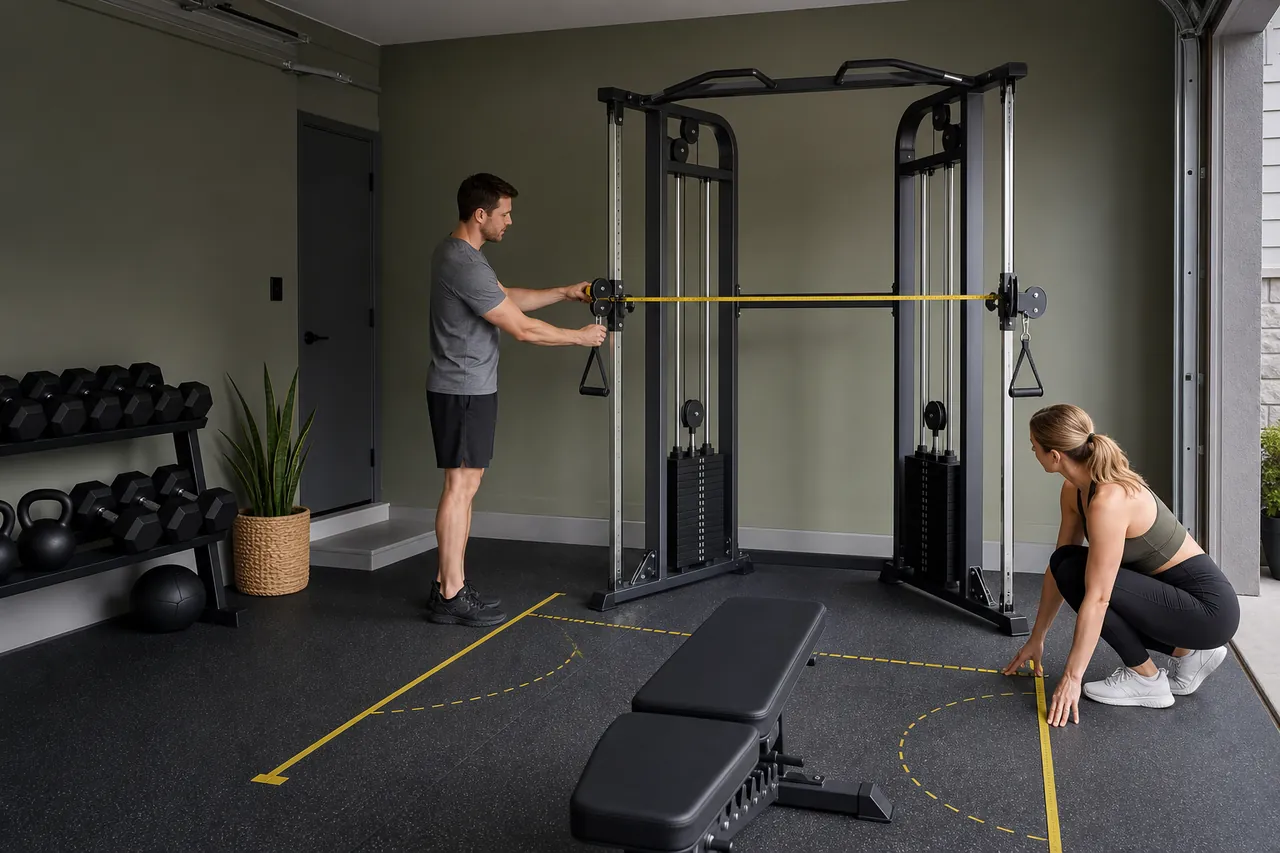
Compare the four cable routesHeader image is AI-generated and illustrative; it shows a generic cable trainer, not a recommended product or product test.
A cable crossover is not defined by a tall frame and two handles. The useful machine is the combination of handle resistance, cable travel, trolley height range, distance between the pulleys, and clear floor around the moving user. A compact trainer can be excellent for curls, raises, presses, and fly variations yet feel limited on heavy rows. A wide machine can create a better starting angle for crossovers while consuming the wall needed for storage or another station.
The shortlist deliberately mixes three standalone functional trainers with one attachment. The MyRack option earns a place because it solves a real buyer job: adding one or two adjustable plate-loaded sides to a rack that is already wanted. It is not a cheap substitute for a complete trainer once the rack, second side, plates, handles, floor clearance, and slower load changes are counted.
Read the cable path
The cable numbers that decide usable exercises
Usable resistance
The approximate load presented at the handle after the machine's pulley ratio.
It is the fair number for comparing rows, pulldowns, presses, and single-arm work.
Divide the selected stack or plate load by the ratio, then confirm the manufacturer's own wording.
A 170-pound stack does not put 170 pounds in one hand on a 2:1 cable.
Pulley ratio
The relationship between cable movement and resistance movement; 2:1 provides about two feet of handle travel for one foot of stack travel.
It trades maximum handle load for longer travel and smaller-feeling increments.
Record the ratio for each handle and for any joined-bar setup.
A lower felt load is not missing weight; it is the routing doing its job.
Cable travel
The maximum distance a handle can move before the cable or stack reaches its stop.
Long split-stance presses, flyes, pull-throughs, and movements away from the frame can run out of cable.
Rehearse the longest intended movement from the actual trolley position.
Machine depth does not reveal how far a handle can travel.
Trolley range
The lowest, highest, and intermediate points where an adjustable pulley can lock.
It controls whether short and tall users can begin curls, raises, pressdowns, and high-to-low work from a useful angle.
Measure the handle start point, not only the top of the upright.
More holes do not help if the usable range starts too high or ends too low.
Pulley spacing
The clear horizontal distance between the left and right cable outlets.
It changes the opening angle for flyes, crossovers, presses, and bilateral movements.
Compare the published spacing or measure a showroom unit with the handles at the intended height.
Overall machine width includes uprights and feet and is not the same as outlet spacing.
Independent stacks
Each handle has its own stack or plate carriage rather than both handles sharing one resistance source.
Two people or two arms can use different loads without one side stealing travel from the other.
Confirm whether joining both handles changes the available resistance or travel.
Two visible handles do not always prove two independent resistance paths.
Selectorized loading
A pin selects plates from a built-in weight stack.
It makes frequent changes fast for circuits, drop sets, and shared households.
Check the first increment, normal increment, top usable handle load, and upgrade-stack cost.
The stack's total mass is not the usable single-handle resistance.
Plate-loaded cable
Olympic or standard plates are added to a carriage that tensions the cable.
It can reduce initial machine cost but adds plate handling, storage, and clearance.
Price the required plates and rehearse loading both sides without blocking another station.
Owning plates does not make every rack attachment compatible.
Anchoring requirement
The manufacturer's instruction to bolt the machine, tower, or rack to a suitable floor or wall.
Cable pulls can create forward, sideways, and rotational forces outside the footprint.
Confirm the substrate, hardware, landlord permission, and final location before delivery.
Heavy stacks alone do not cancel an explicit anchoring instruction.
How the field narrowed
We separated full trainers from rack add-ons
We mapped manufacturer-direct stores and specialist dealers in the US and Europe/UK, then required a current exact product path, two independently positionable handles, a published ratio, a distinct buyer lane, and enough physical and warranty evidence to expose ownership friction.
Review counts, ratings, and current catalog placement helped establish which products buyers are actually encountering. They did not establish smoothness, quietness, reliability, or training outcomes. Those judgments still need a comparable showroom unit or a return window that can absorb freight and disassembly costs.
Resistance is after ratio
Width, travel, resistance, and setup at a glance
| Product | Usable resistance | Geometry | Workflow | Regional status |
|---|---|---|---|---|
| REP Arcadia | 85 lb per handle base; 110 lb with stack upgrade; 2:1 | 55.3 in front width; 35.8 in depth; 81 in travel; 32 positions | Dual pin stacks; smallest increments with add-on weights | US exact order page plus REP Europe exact pages |
| Bells Functional Trainer | About 80 lb per handle from 160 lb stacks; 2:1 | 53 x 30 x 81 in stack frame; 16 positions | Choose weight stack, plate loaded, or later upgrade | US/Canada centered; confirm selected variant stock |
| Powerline PFT100 | About 80 lb per handle base; about 105 lb with 210 lb stacks; 2:1 | 62.6 in wide; 52 in between pulleys; 42.3 in deep; 83 in high | Dual pin stacks; 20 starting positions | US in stock/order paths; European dealer availability varies |
| MyRack Cable Crossover | Half the plates loaded on each side; 2:1 | 104 in cable extension; 28 positions; one-side dimensions only | Buy one or two plate-loaded sides for compatible MyRack | UK in stock; US retail-exclusive route |
Choose the compromise deliberately
Four ways to buy cable freedom
For a shallow room that still needs long cable travel
REP Arcadia Functional Trainer
Arcadia earns the compact lane because its 35.8-inch depth, 55.3-inch front width, 80.8-inch height, 32 trolley positions, and 81-inch travel are all published on the exact page. The dual 170-pound stacks feel like roughly 85 pounds per handle at 2:1, with a 220-pound-per-side upgrade for about 110 usable pounds. That makes it more convincing for varied movement than for buyers equating stack labels with heavy single-handle pulls.
The US exact page had current order controls and REP now operates exact European stores. The long travel, small depth, storage pegs, and micro-load option suit shared home gyms.
Tall-user pressdowns may require knee bend or kneeling, and the base usable load can be light for rows and pulldowns. The stack upgrade is easier to choose before assembly.
Avoid if: your main requirement is heavy single-handle pulling above 85 pounds or a very wide crossover start angle.
Alternative: PFT100 publishes a 52-inch pulley span; Bells offers a lower-cost plate-loaded starting path.
Verify: exact regional stack specification, delivery boxes, ceiling under the pull-up bar, trolley start points for every user, and replacement cable/pulley terms.
For choosing convenience now or adding it later
Bells of Steel Functional Trainer
The Bells trainer is the only standalone option here whose exact page presents a selectorized model, a plate-loaded model, and an upgrade path between them. The stack version is 53 by 30 by 81 inches with two 160-pound stacks, 16 positions, aluminum pulleys, 14-gauge rails, and 2:1 routing. That is a practical value lane for a buyer who understands that loading workflow matters as much as exercise count.
The page showed active order and US pickup controls, 47 reviews, and both loading variants. The frame warranty is limited lifetime and the company lists replacement-parts support.
The same page also displayed a contradictory stock-state wrapper, so exact variant stock needs confirmation. Listed coverage for cables and pulleys is only 90 days, much shorter than the frame.
Avoid if: you will not verify the selected variant in writing or want long stated wear-part coverage.
Alternative: Arcadia has more trolley positions and published travel; PFT100 has the wider published pulley span.
Verify: SKU, stack versus plate version, shipment date, assembled weight, included handles, anchoring guidance, and current cable/pulley replacement price.
For a wider crossover angle and auditable delivery mass
Powerline PFT100 Dual Stack Functional Trainer
PFT100 is the geometry-first choice. Body-Solid states 52 inches between pulley outlets, 62.6 inches overall width, 42.3 inches depth, 83 inches height, and 476.3 pounds assembled. Two 160-pound stacks route at 2:1, with 210-pound upgrades available. It is not the smallest or newest design, but a buyer can plan the wall, floor, doorway, and usable resistance with fewer missing numbers.
The exact manufacturer page showed in-stock ordering, FitnessFactory offered a current freight path, and Body-Solid maintains a large dealer and parts network. Twenty positions and swiveling pulleys cover the normal functional-trainer job.
The wider span consumes wall space, and nearly 500 pounds assembled means staging and assembly need planning. European dealer presence does not mean immediate stock; one checked Netherlands listing was backorder.
Avoid if: 62.6 inches of machine width crowds another station or the delivery route cannot handle the packages and stacks.
Alternative: Arcadia is much shallower and narrower; Bells gives a plate-loaded entry route.
Verify: 160- versus 210-pound stacks, regional warranty holder, threshold service, package count, floor protection, and actual trolley endpoints.
For an existing MyRack plan that needs one or two cable sides
Force USA MyRack Cable Crossover (One Side)
This attachment earns a narrow recommendation, not a budget crown. One side adds 28 adjustable positions, a folding low-row footplate, standard/Olympic plate adapters, 2:1 routing, and a manufacturer-stated 104 inches of cable extension. Buy a second side for independent bilateral crossover work. It makes sense only when the compatible MyRack or Folding MyRack is already the right rack.
The UK exact page showed in-stock ordering, and the US product remains in the current MyRack catalog as a retail-exclusive item. One-side purchasing can stage cost and floor planning.
A complete crossover may require two sides, rack, chin-up crossmember, plates, safeties, handles, floor space, and repeated plate changes. Published one-side dimensions are not the finished two-side envelope.
Avoid if: you do not already want a MyRack, cannot load plates around both uprights, or need quick pin changes for several users.
Alternative: Bells offers a standalone plate-loaded trainer with an upgrade path; Arcadia provides a complete selectorized package.
Verify: rack generation, one- versus two-side cart, connecting parts, regional retail stock, plate clearance, anchoring, and the seller's exact attachment warranty.
Ownership facts after geometry
What arrives, what is known, and who supports it
Design office and headquarters are not manufacturing origin. The checked exact sources do not disclose a country of manufacture for these exact models.
| Product | Size and weight | Construction | Exact-model origin | Brand background | Warranty/support |
|---|---|---|---|---|---|
| REP Arcadia Functional Trainer | 55.3 W front x 35.8 D x 80.8 H in; exact assembled weight not stated on checked exact page. | Steel frame, hot-rolled steel stack plates, galvanized wire cable with raw-steel core. | Not disclosed for this exact model; designed and engineered in Colorado is not origin. | REP Fitness, founded 2012 in Colorado; modular racks, benches, and cable systems with US, UK, and EU operations. | Lifetime frame/structural welds; 1 year pop-pins, pulleys, bearings, cables. Original-purchaser and use/storage limits apply. |
| Bells of Steel Functional Trainer | 53 L x 30 W x 81 H in stack version; assembled weight not stated on checked exact page. | 14-gauge steel rails, powder coat, aluminum pulleys, steel stacks or Olympic plate carriages. | Not disclosed by the manufacturer for this exact model. | Bells of Steel, started 2010 in Calgary; home-gym and strength-sport equipment with US operations in Indianapolis. | Limited lifetime frame against defects; 90 days cables and pulleys; normal wear and cosmetic exclusions. |
| Powerline PFT100 Dual Stack Functional Trainer | 62.6 W x 42.3 D x 83 H in; 476.3 lb / 216 kg assembled; 52 in between pulleys. | Steel frame, dual cast-iron stacks, adjustable swiveling pulleys, nylon cable handles. | Exact model not disclosed; Body-Solid states manufacturing is worldwide generally. | Powerline by Body-Solid; parent founded 1989 in Chicago and based in Forest Park, Illinois, with international dealers. | 10 years frame/welds; 1 year bushings, hardware, pads, rollers, grips, and other parts under Powerline terms. |
| Force USA MyRack Cable Crossover (One Side) | One side: 220 H x 110 W x 80 D cm; exact attachment weight not stated; finished system depends on rack and side count. | Steel upright and plate holders, floating trolley pulley, folding footplate, plate adapters, cable routing. | Not disclosed by the manufacturer for this exact attachment. | Force USA, established 2008; US operating base in Draper, Utah, with UK/EU regional stores. | UK home wording: lifetime frame, 3 years moving parts, 6 months attachments/wearing parts. Confirm the actual seller/market terms. |
Use the room, not the product photo
Rehearse the full cable rectangle
Select a route and enter the clear wall width and room depth for a first screen. Then tape the actual handle and bench paths; the result is not a safety or fit certification.
- Mark the machine feet, both stack-service sides, pull-up body, and any anchor points.
- Set each trolley low, chest-high, and high. Walk the handle to the end of the published travel without crossing doors, lights, cars, or storage.
- Place the real bench for presses, flyes, rows, and pullovers. Mark wheels, back-pad tilt, head clearance, and the route used to remove it.
- Rehearse the tallest user's pressdown and the shortest user's curl. Confirm useful start angles rather than counting holes.
- For plate-loaded routes, add the plate cart, loading hand space, and the path used to change both sides.
A shared gym changes the winner
Score the weak-side workflow
Set up one exercise that uses different loads left and right, one that changes load every set, and one that uses both handles joined to a bar. Time the complete transition, including trolley movement, pin or plate changes, attachment swaps, and walking around a bench.
Can each user select the needed increment without add-on plates, bands, or a workaround?
Can left and right use different resistance while preserving full cable travel?
Does joining handles provide enough load, and where does the bar or attachment begin?
Can the next person restore both trolleys, handles, and loads without moving stored plates or a bench?
A plate-loaded option can be rational for one patient owner with existing iron. A pin-loaded option can be worth more in a household where every set would otherwise require four plate movements.
Price the exercises you named
Write the attachment bill before checkout
Included pair
Record the exact D-handles, carabiners, chains, storage hooks, and pull-up bar supplied with the chosen SKU.
Long and heavy pulls
Price the lat bar, row bar, connector, foot brace, knee hold, and any stack upgrade needed for the planned load.
Lower-body work
Add an ankle cuff, belt, rope, and enough clear cable path for pull-throughs or split-stance movements.
Ownership parts
Record cable, pulley, bearing, pop-pin, lubricant, touch-up, anchor hardware, freight, and service access.
The machine with the lowest frame price can become the expensive choice when it needs a second side, rack, plates, stack upgrade, several handles, or freight that a complete model already includes.
A cable trainer is not every station
When a cable crossover is the wrong machine
Heavy pulldowns dominate the plan
A dedicated lat/low-row with knee restraint and a heavier 1:1 path may be more stable and simpler than joining two light 2:1 handles.
The wall is narrow
A single compact cable tower can beat a dual-upright trainer when cross-body and unilateral work matter more than wide bilateral flyes.
Barbell safety is the missing job
A functional trainer is not automatically a power rack. Buy rated safeties and rack geometry when squats and presses are the actual priority.
Anchoring is impossible
If the selected system requires bolts and the floor, wall, lease, or radiant heat cannot accept them, choose a manufacturer-approved freestanding alternative.
Put service beside specifications
Ask for travel, replacement, and delivery proof
- Exact identity: product name, SKU, loading variant, stack size, side count, frame revision, and regional seller appear on one order record.
- Geometry: overall dimensions, pulley spacing, cable travel, trolley endpoints, bench path, pull-up headroom, and anchor layout fit the taped room.
- Resistance: ratio and usable single-handle load are written for the base and any upgrade.
- Arrival: package count, heaviest box, curbside/threshold service, route, assembly help, and damage procedure are known.
- Service: frame, cable, pulley, bearing, pop-pin, labor, freight, and commercial/garage exclusions come from the warranty holder.
Buy the cable route whose weakest ordinary task still works: the lightest useful increment, the longest movement, the heaviest repeated pull, the shortest and tallest user, and the replacement part most likely to wear.
Primary references
Exact products, manuals, warranty, and regional sellers
Stock and terms change. Open the page for the country and exact variant that will govern the order.
- REP Arcadia US product and specifications
- REP Arcadia European exact product
- REP Arcadia and Arcadia Max comparison
- REP product warranty
- Bells of Steel Functional Trainer product and warranty
- Bells of Steel company background
- Powerline PFT100 exact product and specifications
- Powerline PFT100 product data sheet
- FitnessFactory PFT100 US order page
- NiemanSports PFT100 European listing
- Body-Solid company history and international distribution
- Force USA MyRack Cable Crossover US product
- Force USA MyRack Cable Crossover UK product
- Force USA MyRack cable-extension support
- Force USA MyRack builder and compatibility
Product and brand names identify the recommendations editorially. No price, rating, review, availability schema, or marketing claim is presented as hands-on evidence. The header is AI-generated.