Fitness bands · checked
Best Fitness Trackers for Phone Fit, Battery and Apps
Bottom line: choose the phone and app relationship before the sensor list. Amazfit Band 7 is the low-cost, long-charge option; Samsung Galaxy Fit3 is the large-screen Android lane; Fitbit Inspire 3 is the narrow cross-platform band; Garmin vivosmart 5 adds a physical button and Garmin Connect; Fitbit Charge 6 is the onboard-GPS and Google-services choice.
This guide compares slim band-style trackers, not watch-shaped trackers or rings. We checked current maker specifications, app requirements, support pages, bundle records, and US retailer availability. We did not wear or compare these devices. Consumer sensor outputs are estimates, and these trackers are not medical devices for the purposes of this guide. Do not use this article to interpret any output medically.
Start here: iPhone or Android, required account, app-store support, and whether GPS must work without a phone.
Avoid: paying for a feature whose app, membership, or phone requirement you will not accept.
Verify at checkout: exact SKU, wrist size, box contents, current app requirements, optional paid layers, warranty region, and return window.
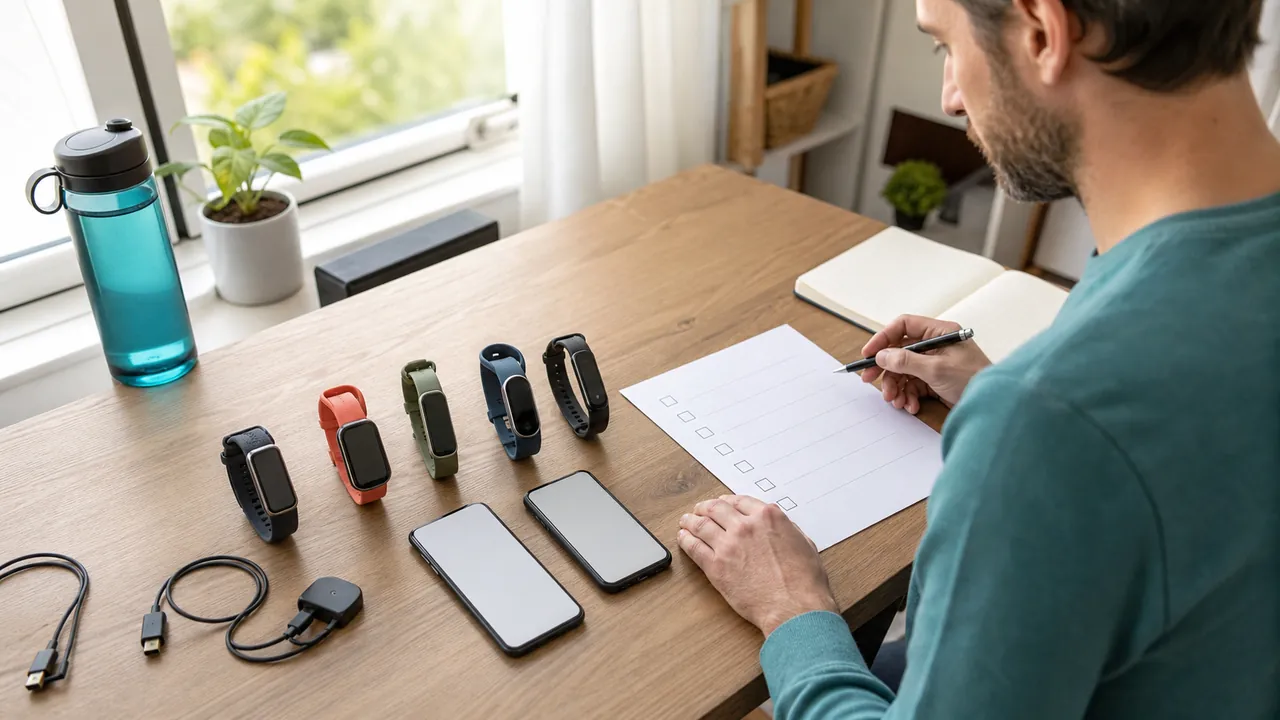
AI-generated editorial image; it is not evidence of product testing.
Decode the ownership contract
The terms that decide whether a tracker fits your life
A fitness band is a small display, battery, sensors, radio, app, account, and support policy sold as one experience. These seven terms turn that stack into practical checkout questions.
Phone compatibility
Plain meaning: the phone operating systems and models the companion app supports.
Why it matters: a tracker can turn on yet still lack normal setup, syncing, or notifications with an unsupported phone.
Check: confirm your exact phone and current OS against the maker's live compatibility page.
Common mistake: reading “Bluetooth” as proof that every phone works.
Required app and account
Plain meaning: the phone software and sign-in needed to set up, sync, update, and view data.
Why it matters: the app is part of the product, not a detachable bonus.
Check: install the current app, read its store listing, and decide whether its account requirement is acceptable before ordering.
Common mistake: assuming the band remains fully useful as a stand-alone watch.
Optional subscription
Plain meaning: a recurring payment unlocks some app content or services while core device use continues without it.
Why it matters: an included trial can make the first months look different from later ownership.
Check: list the exact features you want and mark each as included, trial, or paid.
Common mistake: treating “optional” as irrelevant without checking which screens or services sit behind it.
Onboard GPS and connected GPS
Plain meaning: onboard GPS obtains route position on the tracker; connected GPS borrows the paired phone's positioning.
Why it matters: connected GPS normally means carrying the phone when a route record matters.
Check: decide whether the phone will be present, charged, paired, and permitted to share location.
Common mistake: seeing “GPS” in a listing without asking where the receiver lives.
Always-on display
Plain meaning: the screen can keep a reduced view visible instead of waking only by touch or wrist motion.
Why it matters: visibility improves, but charging can become more frequent.
Check: compare maker battery claims with always-on mode enabled and disabled where those figures exist.
Common mistake: assuming the headline battery number includes every display setting.
5 ATM water rating
Plain meaning: the device passed a pressure-based water-resistance standard stated by the maker.
Why it matters: it is not a permanent waterproof promise; seals can change with age, damage, repair, heat, and use.
Check: follow the exact maker guidance for the device, band, water type, temperature, and drying.
Common mistake: translating “50 meters” into permission for every activity at that depth.
Manufacturer battery estimate
Plain meaning: an “up to” duration measured under a maker's stated settings and usage pattern.
Why it matters: display mode, notifications, GPS, syncing, and other enabled features change the interval.
Check: build a charging plan from your intended settings, then use the return window to observe your own interval.
Common mistake: treating five different “up to” claims as one standardized battery test.
How the shortlist was built
Current models and distinct ownership lanes
We started with live manufacturer sales and support pages, then used Best Buy and Target to confirm exact US orderability and visible review volume. Each included model has a different practical reason to exist: price and charge interval, Android display size, narrow cross-platform form, physical-button navigation, or onboard positioning and Google services.
We excluded discontinued generations, marketplace clones, and bands without a clear official US sales or support path. Popularity formed the candidate pool but did not prove quality. Sensor performance was not ranked or interpreted; every consumer sensor output remains an estimate.
The shortlist at a glance
Compare the phone, screen, battery, and recurring cost first
Battery figures below retain maker wording and are not one shared test. Water ratings are purchase-screening facts, not permanent guarantees. App and subscription terms can change, so recheck the live pages before paying.
| Model | Phone/app | Display | Maker battery claim | Water rating | Paid layer / main caution |
|---|---|---|---|---|---|
| Amazfit Band 7 | Zepp; Android 7+ / iOS 12+ | 1.47 in AMOLED, 198 x 368 | Up to 18 days typical; 12 heavy; 28 saver | 5 ATM | No required core subscription stated; connected GPS only |
| Samsung Galaxy Fit3 | Android only; Galaxy Wearable / Samsung ecosystem | 1.6 in AMOLED, 256 x 402 | Up to 13 days; up to 3.5 with always-on in maker test | 5 ATM + IP68 | No required paid membership stated; no iPhone support |
| Fitbit Inspire 3 | Google Health; Android 11+ / iOS 16.4+ | AMOLED with Gorilla Glass 3 | Up to 10 days | 50 m maker claim | Optional Google Health Premium; no onboard GPS |
| Garmin vivosmart 5 | Garmin Connect; compatible Android/iOS | 10.5 x 18.5 mm monochrome OLED; button | Up to 7 days | 5 ATM | No required paid membership stated; connected GPS |
| Fitbit Charge 6 | Google Health; Android 11+ / iOS 16.4+ | AMOLED with Gorilla Glass 3; always-on option | Up to 7 days | 5 ATM / 50 m maker claim | Optional Google Health Premium; YouTube Music controls may require paid plan |
Recommendations by buyer lane
Choose the constraint you will notice every day
Best budget lane and longest charge claim
Amazfit Band 7
Why it fits: the current US page combines a 1.47-inch AMOLED panel, Android and iPhone support, a 5 ATM rating, and an up-to-18-day typical-use claim at the lowest usual price lane in this shortlist.
Useful strengths: 28 g with strap, clear published dimensions, Zepp app support, phone music controls, magnetic cable, and no required recurring payment stated for core setup.
Tradeoff: route positioning is connected through the phone rather than onboard, and the saver-mode headline disables several normal functions.
Skip it if: you require phone-free route recording or want to stay inside Google, Samsung, or Garmin's app history.
Also compare: Inspire 3 for a narrower, lighter cross-platform band.
Check before keeping: confirm Zepp accepts the exact phone and treat route maps as phone-dependent. Manufacturing origin and a product-page warranty term remain undisclosed.
Best large-display band for Android
Samsung Galaxy Fit3
Why it fits: the 1.6-inch AMOLED is the largest display here, with a side button, up-to-13-day claim, 5 ATM/IP68 ratings, and Samsung phone-notification controls.
Useful strengths: 42.9 x 28.8 x 9.9 mm aluminum body, 18.5 g body weight, a clearly stated Android-only boundary, and current US retail evidence.
Tradeoff: there is no iPhone path, and some watch-face or phone-control details can vary between Galaxy and other Android phones.
Skip it if: the recipient uses iPhone, changes between phone ecosystems, or does not want Samsung app/account dependencies.
Also compare: Inspire 3 when cross-platform support matters more than display area.
Confirm the phone: install the current Samsung apps on the recipient's exact Android model, then verify US box contents and the model-specific warranty in Samsung's lookup.
Best narrow cross-platform band
Fitbit Inspire 3
Why it fits: at 39.32 x 18.6 x 11.75 mm and 17.69 g, it is the smallest stated body and lightest stated complete tracker here, while supporting current compatible Android and iPhone versions.
Useful strengths: AMOLED/Gorilla Glass 3 display, small and large bands in the box, up-to-10-day claim, and a Google-published minimum security-support date through at least February 2028.
Tradeoff: it requires a Google Account, Google Health app, internet connection, and phone GPS for route positioning; Premium is an optional paid layer.
Skip it if: you require onboard GPS, reject the required Google setup, or want a physical navigation button.
Also compare: vivosmart 5 for a button and Garmin Connect.
Confirm the account: complete the Google Health setup and phone-GPS check during the return window. Exact tracker-body material and manufacturing origin remain undisclosed.
Best for a physical button and Garmin Connect
Garmin vivosmart 5
Why it fits: a physical button backs up the touchscreen, the monochrome OLED keeps the interface compact, and Garmin Connect provides a current Android/iPhone path without a required paid membership for normal device use.
Useful strengths: two band sizes, 5 ATM rating, up-to-seven-day claim, replaceable silicone band, one-year limited warranty, and a documented support/manual path.
Tradeoff: the 10.5 x 18.5 mm monochrome display is the smallest viewing area here, and route positioning relies on the phone.
Skip it if: color, a larger notification view, or onboard positioning is a priority.
Also compare: Charge 6 for a color display and onboard GPS.
Check the current seller: Target showed this exact model in stock with 1,340 ratings during our check. Confirm band size, stock, and return terms before paying.
Best band for onboard GPS and Google services
Fitbit Charge 6
Why it fits: onboard GPS, a color AMOLED/Gorilla Glass 3 display, side control, Google Maps and Wallet support, and Android/iPhone compatibility make it the broadest services band in this comparison.
Useful strengths: 36.73 x 23.09 x 11.20 mm body, 30 g weight, both band sizes in the box, 5 ATM rating, and strong current retail evidence with more than 2,000 Best Buy reviews.
Tradeoff: the maker claim is up to seven days, Google setup is required, always-on mode charges more often, and some extras involve optional paid memberships.
Skip it if: the app/service stack feels excessive or a much longer charging interval matters more than onboard positioning.
Also compare: Band 7 for the long-charge budget lane or vivosmart 5 for Garmin Connect.
Check the paid layers: list the Google Health Premium and YouTube Music functions you actually want, then confirm the live terms. Manufacturing origin remains undisclosed.
Due diligence after the shortlist
Check wrist fit, casing, origin, and support
Brand headquarters are not manufacturing-origin evidence. Warranty duration and support routes vary by purchase region, seller, and exact SKU, so unknown fields remain unknown rather than inferred.
| Product | Size and weight | Materials | Manufacturing origin | Brand | Warranty and support |
|---|---|---|---|---|---|
| Amazfit Band 7 | 42.33 x 24.36 x 12.2 mm including sensor; 28 g with strap | Polycarbonate body; tempered-glass touchscreen; TPU strap | Not disclosed on current official page | Amazfit launched in 2015 by Zepp Health, established as Huami in 2013 | US duration not stated on checked product page; North American support path published; verify seller/region |
| Samsung Galaxy Fit3 | 42.9 x 28.8 x 9.9 mm body; 18.5 g body excluding strap | Aluminum body; AMOLED display; exact US strap material not confirmed | Not disclosed for exact US model | Samsung Electronics; established 1969 in South Korea; mobile devices and consumer electronics | Samsung US requires model lookup for exact parts/labor period; register exact SKU and verify seller |
| Fitbit Inspire 3 | 39.32 x 18.6 x 11.75 mm; 17.69 g | AMOLED/Gorilla Glass 3; silicone band; plastic buckle and tang; body material not stated | Not disclosed on current official page | Fitbit; Google completed acquisition in 2021; now supported through Google | Current terms vary by region/purchase date; Google claim path; security updates through at least February 2028 |
| Garmin vivosmart 5 | S/M: 19.5 x 10.7 x 217 mm, 24.5 g; large: 19.5 x 10.7 x 255 mm, 26.5 g | Acrylic lens; silicone interchangeable band; monochrome OLED | Made in Taiwan stated in Garmin channel document | Garmin; founded 1989; navigation, outdoor, aviation, and fitness devices | One-year limited warranty; Garmin support/manual path; regional statutory terms can differ |
| Fitbit Charge 6 | 36.73 x 23.09 x 11.20 mm; 30 g | Aluminum case color designation; AMOLED/Gorilla Glass 3; silicone infinity band | Not disclosed on current official page | Fitbit; Google completed acquisition in 2021; current Google Health integration | Current regional Google hardware terms and claim path; security updates through at least February 2028 |
Three choices the sensor list cannot settle
The ownership experience lives mostly off the wrist
Display area versus band size
Galaxy Fit3 shows more at once; Inspire 3 occupies less wrist width. Print the stated body rectangles at actual size, place each on your wrist, and decide whether reading space or narrowness wins.
Onboard positioning versus charging
Charge 6 can obtain route position without borrowing the phone, while the other four rely on a paired phone for mapped routes. Onboard positioning is useful only when you will leave the phone behind and accept its battery cost.
App continuity versus a fresh start
Existing Garmin, Google, Samsung, or Zepp history can reduce switching friction. A lower device price may be poor value if you dislike the required account, cannot import what matters, or need a second app you will not maintain.
Do this before ordering
Run a phone-and-account dry run
Complete all five boxes using the recipient's actual phone. A failed box rejects the tracker before price, color, or sensor features enter the discussion.
Turn “up to” into a workable routine
Build a settings-based charging calendar
Write the display mode, daily notification load, phone-free positioning time, sync frequency, and travel days you expect. Then halve the maker's headline interval for the first calendar draft. This is a planning allowance, not a prediction. Place one charging session where the device is already off the wrist, and keep the proprietary cable where that session happens.
During the return window, record only the time between charges under your chosen settings. Move the calendar to match what you observe. This comparison stays about maintenance and does not use sensor outputs to judge the product.
Use the return window as a compatibility test
Verify the ownership basics in a fixed order
- Photograph the exact SKU and box contents, then keep the packaging and receipt.
- Pair with the phone that will actually be used; complete updates and test one full sync.
- Check text size, brightness, touch targets, button behavior, and notification readability in ordinary indoor and outdoor viewing.
- Confirm which app screens work without a paid plan and note every trial end date.
- Observe charging interval with the intended display and positioning settings; do not compare that observation with another person's routine.
- Open the support and export paths once, then decide before the return deadline whether the app/account relationship is acceptable.
What we checked
Manufacturer, support, and retailer sources
Maker pages support specifications, compatibility, app, bundle, and support statements. Retailer pages support orderability and visible review volume only. No affiliate links are used in this review package.
- Amazfit Band 7 official US specs
- Zepp Health and Amazfit timeline
- Samsung US Galaxy Fit3 support
- Fitbit Inspire 3 official specs
- Garmin vivosmart 5 current listing
- Garmin vivosmart 5 manual specifications
- Garmin Connect compatibility requirements
- Fitbit Charge 6 official specs
- Google Fitbit security-update policy
- Best Buy Inspire 3 review signal
- Target vivosmart 5 orderability and review signal
- Best Buy Charge 6 review signal
Models, apps, and stock change. If you spot an error, send Garage Gym Power a correction.
Last exact-model and orderability check: July 18, 2026. Recheck app support, subscription terms, stock, warranty, band sizing, and box contents before paying.