Surface first, membrane second
Best Winter Running Shoes for Wet Roads, Snow and Ice
Bottom line: Nike Pegasus 41 GORE-TEX is the neutral wet-road starting point; Brooks Adrenaline GTS 24 GTX is only for runners who already want structured support; HOKA Speedgoat 6 GTX adds trail lugs for loose wet ground and snow; Icebug Arcus 2 BUGrip GTX adds 13 steel studs for routes dominated by hard ice.
We checked exact current models, manufacturer details and specialist stock on . We did not run in these shoes or measure grip. No outsole, waterproof membrane or stud makes a winter surface slip-proof.
Start here: classify the worst surface you meet every week, not the nicest first mile.
Avoid: buying “waterproof” as though it also means ice traction.
Verify: fit with winter socks, current drop/support continuity and indoor rules for studs.
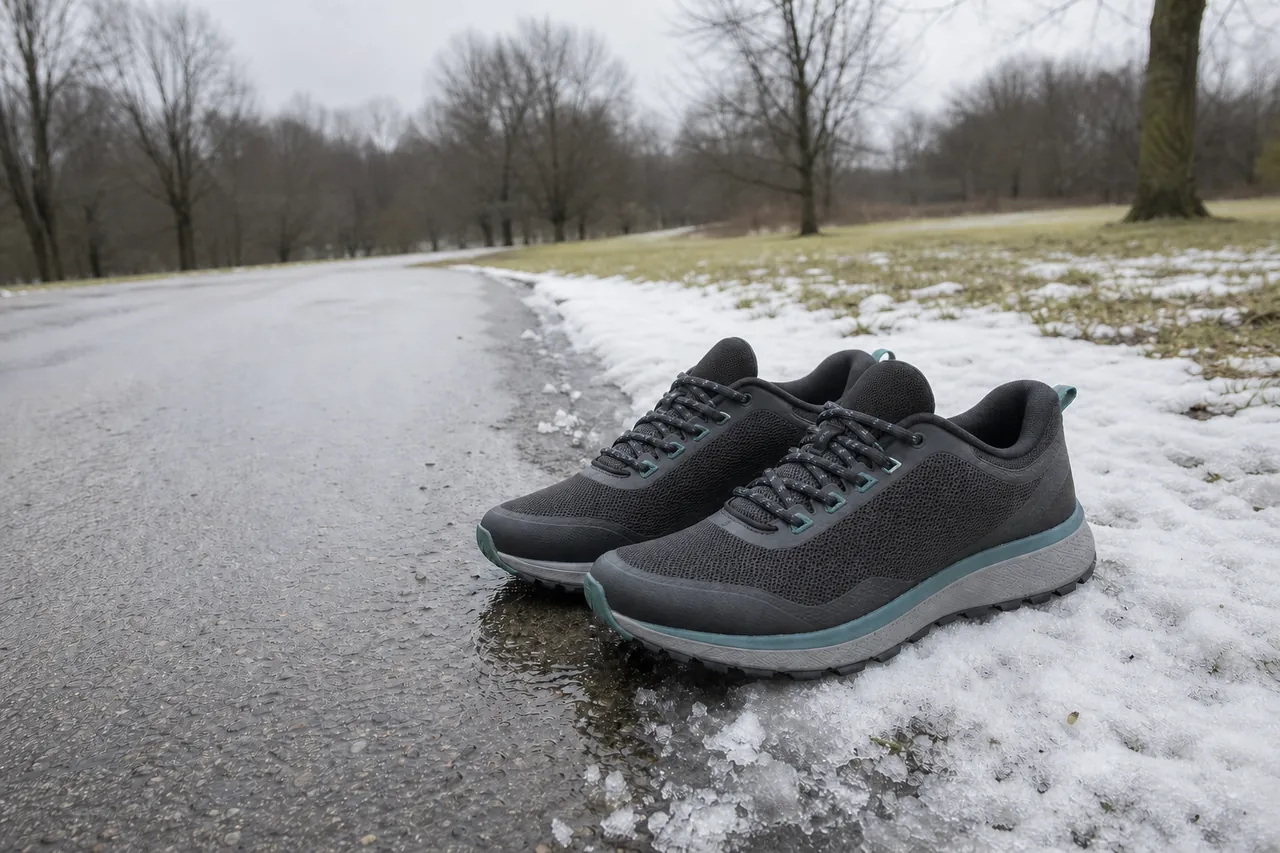
Write down where rubber stops being enough
Use one week of normal routes. Count the minutes on wet bare road, loose snow or mud, and hard bonded ice. The dominant hazardous surface decides the outsole; rain and slush decide whether a membrane is worth its slower drying and warmer feel.
| Recurring surface | Traction tool | Start with | Boundary |
|---|---|---|---|
| Wet bare road | Road rubber shaped for wet weather | Nike Pegasus 41 GTX | Not a hard-ice outsole |
| Wet road, structured support already preferred | Road outsole plus familiar GuideRails geometry | Brooks Adrenaline GTS 24 GTX | Support is preference continuity, not a diagnosis |
| Wet trail, loose snow, mud | 5 mm lugs and trail rubber | HOKA Speedgoat 6 GTX | Rubber lugs are not steel studs |
| Frequent hard ice | Purpose-built carbide-steel-tip studs | Icebug Arcus 2 BUGrip GTX | Studs still do not guarantee footing |
If the route changes between bare shop floors and ice, include the transition in the decision. Studs can be a poor match for delicate indoor flooring even when they are the right outdoor tool.
What the outsole and upper are actually telling you
Waterproof upper
A membrane and upper construction designed to block outside water.
It helps with rain, splash and shallow slush.
Check the exact GTX style and collar height.
Water can still enter over the collar, and internal moisture dries more slowly.
Lug depth
The height of tread projections that bite into soft ground.
Deeper 5 mm trail lugs shed and engage loose soil better than shallow road patterns.
Match lug depth to snow, mud and trail rather than buying by appearance.
Deep rubber lugs are not automatically good on smooth ice.
Carbide-steel-tip stud
A hard metal traction point built into the outsole.
It addresses hard ice, a different surface from wet asphalt or loose snow.
Check local race, building and floor restrictions before wearing studs.
Studded does not mean impossible to slip.
Dynamic stud
Icebug's studs can move within their outsole seats under load.
The system is designed for changing winter surfaces.
Inspect for missing studs and use the brand's replacement process.
Movement does not make metal invisible on every hard indoor floor.
Heel-to-toe drop
The height difference between heel and forefoot underfoot.
These choices span 5, 10 and 12 mm, which can feel unlike your current shoe.
Compare with the model you already tolerate before changing it for winter.
No single drop is universally correct or a treatment.
Stack height
The amount of shoe between foot and ground at heel and forefoot.
It affects underfoot height and trail feel.
Use figures only when the seller states its measurement method.
More stack does not prove more stability or winter grip.
Structured support
Brooks' Adrenaline lane adds GuideRails geometry intended to influence excess movement.
It makes the Adrenaline meaningfully different from the neutral Pegasus.
Choose it for continuity with a support shoe you already prefer.
A product guide cannot prescribe support from pain, posture or gait.
Winter sock fit
The actual shoe volume left after using the sock planned for cold runs.
A thicker sock can crowd toes or change heel hold.
Try both shoes late in the day with those socks and check downhill toe clearance.
Buying a half size larger by rule is less reliable than trying the system.
Compare the traction system before the foam
| Shoe | Surface lane | Weight* | Drop | Outsole |
|---|---|---|---|---|
| Nike Pegasus 41 GTX | Wet road | 297 g | 10 mm | Storm Tread; no studs |
| Brooks Adrenaline GTS 24 GTX | Wet road, structured support | 317.5 g | 12 mm | Road rubber; no studs |
| HOKA Speedgoat 6 GTX | Wet/loose/snowy trail | 295 g | 5 mm | Vibram Megagrip, 5 mm lugs |
| Icebug Arcus 2 BUGrip GTX | Hard ice and snow | Brand gives no figure | Brand gives no figure | 13 dynamic steel studs |
*Men's reference sizes differ by brand/retailer, so weight is not a race ranking.
Current stock had to survive the surface test
We searched manufacturer stores, Running Warehouse, REI and i-Run, then required a currently orderable exact model, a clear surface lane, a meaningful drawback and support details. Nike shows broad EU sizes and more than 100 men's-page reviews. Brooks is orderable in US and EU stores with more than 75 reviews on each cited page. Official HOKA and Running Warehouse pages show exact model 1155150 order paths while i-Run lists multiple men's and women's variants. Icebug direct lists M7–M13 and more than 200 reviews.
Review totals and “Highly Rated” labels establish market presence, not grip quality. REI's unavailable Speedgoat listing was not allowed to prove current stock. We also rejected the common shortcut of treating every GORE-TEX shoe as interchangeable.
The recommendations and their disqualifiers
Neutral wet-road daily running
Nike Pegasus 41 GORE-TEX
Choose it when winter mostly means rain, wet asphalt and shallow splash. Style FQ1356 combines a waterproof GTX upper, Storm Tread outsole, 10 mm drop and about 297 g men's reference weight.
Advantage: broad current sizes, strong cross-market review signal and familiar road geometry.
Tradeoff: its road tread does not become an ice tool because Nike calls it winterized.
Avoid if: hard ice or loose trail is a normal part of the route.
Alternative: Adrenaline GTX for an established structured-support preference.
Style, weight, drop, upper and Vietnam origin for exact style FQ1356-001 are direct manufacturer disclosures.
Wet roads with structured support already in the brief
Brooks Adrenaline GTS 24 GTX
This lane exists for continuity, not correction. The men's model publishes 317.5 g, 12 mm drop, GTX Invisible Fit and Brooks' GuideRails system.
Advantage: clear support identity, current US/EU orderability and men's/women's versions.
Tradeoff: it is heavier and higher-drop than the Pegasus, and buyer reviews include waterproofing complaints that specifications alone cannot resolve.
Avoid if: you do not already know you prefer structured-support shoes.
Alternative: Pegasus 41 GTX for a neutral wet-road lane.
Core construction is manufacturer-sourced; real fit and water ingress require a return-window trial.
Loose snow, wet trail and soft ground
HOKA Speedgoat 6 GTX
Model 1155150 changes the ground interface: 5 mm Vibram Megagrip lugs, GTX Invisible Fit, 5 mm drop and a 37/32 mm specialist-retailer stack.
Advantage: trail-specific tread and protection with a current official HOKA order path, US specialist stock and broad European listings.
Tradeoff: 5 mm lugs can feel excessive on bare road and still are not carbide studs.
Avoid if: most miles are smooth pavement or hard glazed ice.
Alternative: Arcus 2 BUGrip when hard ice, not loose trail, dominates.
The official exact-model page and specialist specifications align; exact factory and a universal warranty term are not verified.
Frequent hard ice where steel belongs in the plan
Icebug Arcus 2 BUGrip GTX
The Arcus is the only recommendation here with 13 dynamic carbide-steel-tip studs. It also uses a waterproof GORE-TEX ePE membrane and is orderable directly in men's and women's variants.
Advantage: purpose-built hard-winter traction, replacement-stud support and more than 200 current product reviews.
Tradeoff: studs complicate indoor transitions; Icebug gives no current exact-model weight, drop or stack figure.
Avoid if: winter means mainly bare road, indoor errands or flooring that prohibits metal studs.
Alternative: Speedgoat 6 GTX for loose snow and trail without steel.
The stud count, membrane and Vietnam origin are direct; missing geometry stays missing.
Model weight, traction, origin and support
| Product | Size and weight | Materials | Manufacturing origin | Brand | Warranty/support |
|---|---|---|---|---|---|
| Nike Pegasus 41 GTX | Approx. 297 g men's size 9/44; dimensions not disclosed | Technical mesh/GTX; ReactX and Air Zoom; Storm Tread | Vietnam for exact style FQ1356-001 | Nike; Beaverton; company roots in 1964; athletic footwear | Most US flaw claims within two years of manufacture; region/purchase route applies |
| Brooks Adrenaline GTS 24 GTX | 317.5 g men's; dimensions not disclosed; 12 mm drop | GTX Invisible Fit; DNA LOFT v3; GuideRails | Not disclosed for style 110453 | Brooks; Seattle; founded 1914; running gear | Defect evaluation; normal wear and useful life assessed case by case |
| HOKA Speedgoat 6 GTX | 295 g men's retailer sample; 37/32 mm retailer stack; 5 mm drop | Recycled mesh; GTX; CMEVA; Vibram Megagrip | Not verified for model 1155150 | HOKA; Goleta; established 2009; cushioned running footwear | Seller/region specific; Australia states six months against defects |
| Icebug Arcus 2 BUGrip GTX | Exact weight, drop, stack and dimensions not disclosed; size guide provided | GTX ePE; Super C Foam; 13 carbide-steel-tip studs | Vietnam under Icebug's all-shoes disclosure | Icebug; Jonsered, Sweden; founded 2001; traction footwear | No fixed term found; defect review, repair and replacement-stud support |
Waterproof shoes can still end a run wet
Membranes block outside water through the upper; they do not seal the ankle opening or remove sweat. A low shoe filled from above can hold water longer than an open mesh shoe. Rotate and air-dry footwear according to the brand's care instructions rather than applying direct heat.
Changing outsole, drop, stack, support and sock thickness in one purchase makes fit feedback hard to interpret. Preserve the geometry you already understand where possible, then change only the traction tool demanded by the route.
Walk the exact transition points before running them
- Wear winter socks and lace both shoes. Check heel hold, toe spread and a thumb-width-style personal clearance without assuming a universal size-up.
- Walk the steepest safe section and a downhill. Stop for toe contact, heel lift or side pressure; do not expect break-in to fix a wrong shape.
- Map every lobby, shop floor, footbridge and bare-pavement stretch. For studs, confirm metal is permitted and manageable at those transitions.
- Inspect the outsole after the short trial. If the route still exceeds the traction tool, change the route or conditions rather than treating the shoe as permission.
Gift-buyer script
Ask: “What exact shoe and size do you run in now? Is winter mostly wet road, loose snow/trail or hard ice? Do you already choose a support shoe? Must the shoes cross indoor floors?” Without those answers, a returnable gift card is more useful than a surprise geometry change.
Open the exact model before ordering
- Nike Pegasus 41 GTX men's page
- Nike Pegasus 41 GTX women's page
- Nike shoe warranty help
- Nike company history
- Nike Pegasus 41 GTX exact-style origin
- Brooks Adrenaline GTS 24 GTX US
- Brooks Adrenaline GTS 24 GTX EU
- Brooks defect guidance
- Brooks history
- HOKA Speedgoat 6 GTX exact model
- Running Warehouse Speedgoat stock
- Speedgoat 6 GTX specifications
- i-Run Speedgoat inventory
- HOKA Australia defect policy
- Deckers/HOKA company information
- Icebug Arcus 2 product page
- Arcus 2 technical overview
- Icebug winter running guide
- Icebug company history
- Icebug all-shoes manufacturing disclosure
- Icebug repair and shoe care
Found a changed model, specification or stock state? Email the editorial team the exact model, region, URL and date.