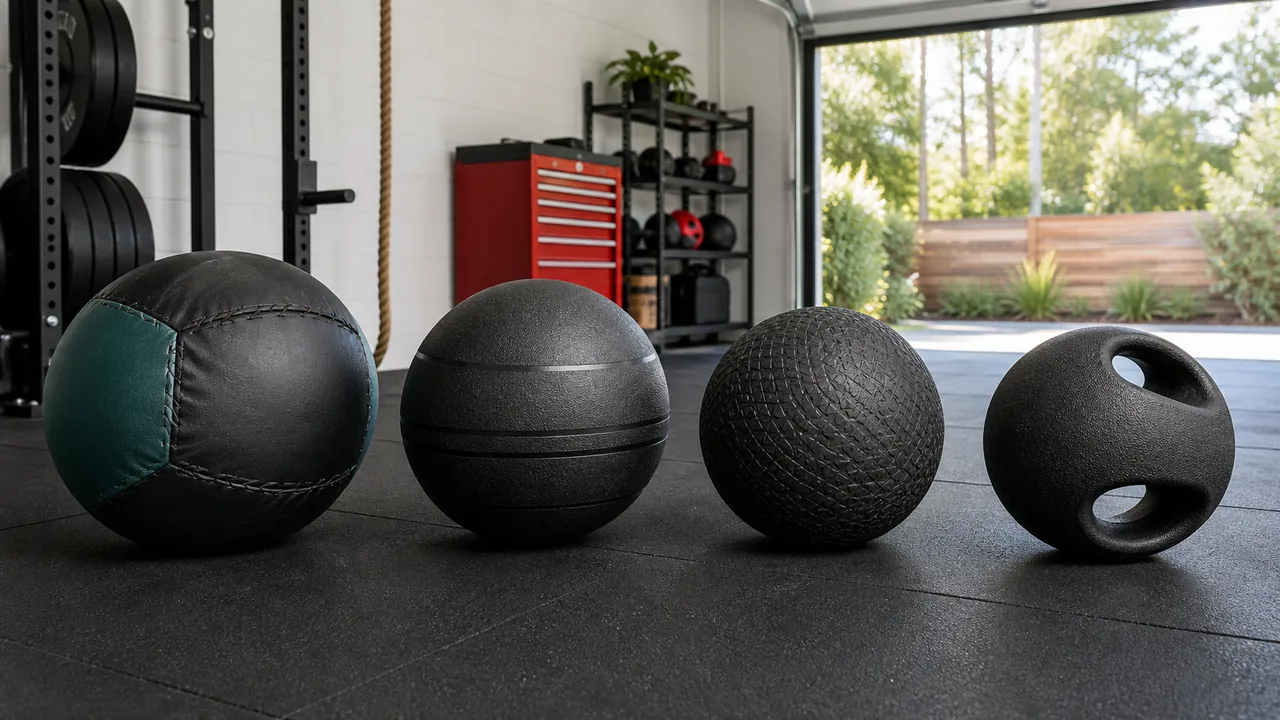
What we checked: current manufacturer specifications, regional ordering pages, warranty documents, specialist-store availability, and observable review or retailer-popularity signals. We did not use or physically test these balls. Bounce feel, grip, residue, seam quality, and the delivered variant still need an arrival check. This is equipment-selection guidance, not exercise or medical advice.
Start with the surface the ball will meet
| Pick | Primary job | Expected behavior | Disqualifier |
|---|---|---|---|
| Rogue Medicine Ball | Wall targets and controlled partner tosses | Large, soft stitched catch surface | The ball will be driven into the floor |
| REP Slam Ball | Repeated floor slams | Sand-filled shell with low return bounce | You need a rigid sphere or predictable rebound |
| Rogue Rubber Medicine Ball | Deliberate wall or ground rebound | Resilient rubber returns energy | The return path is crowded or rebound is unwanted |
| Escape Multi Grip Medball | Handled carries and controlled rotations | Two integrated grip openings fix hand orientation | You mainly need ordinary throws and catches |
The category name is unusually unhelpful. A stitched wall ball, a sand-filled slam ball, a resilient rubber ball, and a handled ball can all be sold as medicine balls even though they should not meet the same surface in the same way. Read the maker's restriction for the exact family and write down the intended wall or floor before comparing weights.
Then check diameter. The Rogue stitched ball remains 14 inches across from 4 to 30 lb, while REP's slam-ball diameter steps up as the load rises. Rogue's rubber model also changes diameter by weight band. The load printed on the shell does not tell you whether the ball fits a shelf, clears a rack opening, or can be carried through the room without striking another object.
Translate the product page before choosing a ball
Low or dead bounce
Meaning: the ball is built to absorb most floor-impact energy instead of springing back.
Why it matters: this separates a slam ball from a resilient rubber ball.
Check: confirm the exact maker page permits floor slams and names an appropriate surface.
Often misunderstood: low bounce does not mean no movement. Sand can settle, shift, and leave the ball slightly out of round.
Rebound
Meaning: the shell returns energy after wall or floor contact.
Why it matters: the ball may come back quickly and along a path the room must keep clear.
Check: name the return lane and remove rebound balls from consideration if that lane crosses people, glass, vehicles, lights, or equipment.
Often misunderstood: a durable rubber shell is not proof that overhead slams are permitted; Rogue explicitly excludes them for its Rubber Medicine Ball.
Stitched wall ball
Meaning: a large, soft-sided ball assembled from panels around internal fill.
Why it matters: its broad catch surface and fixed diameter feel different from a compact rubber sphere.
Check: confirm the target, overhead clearance, seam condition, and the maker's impact exclusions.
Often misunderstood: soft construction does not make it a slam ball. Repeated hard floor impact can void coverage.
Diameter band
Meaning: some product families become physically larger at heavier listed weights.
Why it matters: a larger version changes hand span, shelf depth, bin capacity, and the space needed to pick it up.
Check: use the dimension for the exact weight, not a photo or a family-wide average.
Often misunderstood: the heaviest and lightest variants are not always the same size. REP and Rogue Rubber both use multiple diameter bands.
Shifting fill
Meaning: internal sand moves as the shell changes direction or comes to rest.
Why it matters: the object may settle differently from a rigid, evenly distributed rubber ball.
Check: inspect the delivered shape, roll it slowly, and compare the behavior with the exact product description before hard impact.
Often misunderstood: ordinary settling is not automatically damage, but a leak, split, failed valve, or severe deformation belongs in the seller's return process.
Integrated handles
Meaning: molded openings provide one- or two-hand positions in the ball body.
Why it matters: they create a fixed orientation for carries and controlled rotations.
Check: make sure the intended movement benefits from handles and that the openings suit the user's hands.
Often misunderstood: handles are not a universal upgrade. They interrupt a normal spherical catch and can make the ball a poor substitute for a wall ball.
Home vs commercial warranty
Meaning: coverage can change with the place and manner of use.
Why it matters: REP publishes one year for home use but six months for commercial use.
Check: read the current policy for the buyer's country, seller, and intended setting before paying.
Often misunderstood: a retailer return window is not the same as a manufacturer's product warranty.
Made in vs brand base
Meaning: product origin names where the exact item is made or assembled; brand base names where the company operates.
Why it matters: one does not prove the other.
Check: use exact-model wording or the physical label. Ask the seller when origin affects the decision.
Often misunderstood: REP's Colorado base and Escape's UK/US operations do not establish where these exact balls are manufactured.
Choose by what should happen after impact
Large stitched ball for wall targets
Rogue Medicine Ball
Choose this when a broad, soft catch surface and consistent physical size matter. Rogue lists eleven 4-30 lb variants at the same 14-inch diameter, so moving between weights does not quietly change the shelf footprint or overall ball size. The exact family was orderable in the US and Europe when checked. Its product pages displayed 298 US reviews and 268 European reviews.
The construction limit is as important as the range: Rogue says the ball is not suitable for slams and excludes damage from repeated impact on hard, rough surfaces or forceful overhead floor throws from the European warranty. A priced variant and an add-to-cart control establish orderability, not immediate dispatch to every postcode.
- Eleven weights from 4 to 30 lb
- Same 14-inch diameter throughout
- Exact US and European ordering
- Exact-model US manufacture stated
- Large storage footprint
- Not built for floor slams
- Regional dispatch timing still needs checking
Avoid if: the primary contact is the floor, the shelf is shallower than the full diameter, or the chosen target is not suitable for repeated ball contact.
Alternative: REP Slam Ball for permitted low-rebound floor impact.
Verify before buying: exact-weight stock and delivery estimate, target permission, and the current impact exclusions for the buyer's market.
Low-rebound ball for floor slams
REP Slam Ball
REP is the clearest fit here when the intended action ends on a smooth, debris-free floor and a strong return bounce is unwanted. The rubber-and-sand construction is listed from 5 to 70 lb in the US and 2 to 30 kg in Europe. Current exact-family storefronts were orderable in both regions. The US page displayed 279 reviews; the checked French and Croatian pages each displayed two, so the stronger shopper-attention signal is US-led.
Do not carry one dimension across the whole family. REP publishes 9-10, 11-12, and 13-14 inch bands in the US, while its European page groups 2-12 kg at 9 inches and 15 kg or more at 11 inches. The shifting fill is part of the design, but it also makes a careful arrival inspection useful. REP describes slam balls as consumable goods and gives commercial use only six months of coverage.
- Broad light-to-heavy regional ranges
- Purpose-built low-rebound behavior
- Current US and multi-country EU ordering
- Diameter bands are published
- Sand shifts inside the shell
- Ball size grows with weight
- Commercial warranty is six months
Avoid if: the movement needs a reliable return bounce, a rigid sphere, or a stitched catching surface.
Alternative: Rogue Rubber Medicine Ball when deliberate rebound is required.
Verify before buying: the exact regional diameter, the intended floor surface, and whether the purchase counts as home or commercial use.
Resilient rubber ball for intentional rebound
Rogue Rubber Medicine Ball
This is the conventional rubber choice for a buyer who explicitly wants the ball to come back from a wall or ground contact. Rogue lists nine 6-30 lb variants, a tread-pattern exterior, and three diameter bands. It also gives the clearest disqualifier on the page: do not use it for overhead slams because the rebound is strong.
The exact US and European pages both exposed priced variants and add-to-cart controls; they displayed 44 and 36 reviews respectively. Recent owner reports on Rogue's pages mention initial odor or oily residue, more bounce than some rooms could accommodate, and isolated shell failure. Those reports do not establish prevalence, but they justify inspecting and cleaning only within the maker's care guidance before the return window closes.
- Nine weight increments
- Published diameter bands
- Exact US and European ordering pages
- Clear rebound and no-overhead-slam language
- Return path must stay clear
- Exact manufacturing country not disclosed
- Residue or odor deserves an arrival check
Avoid if: the room is crowded, dead bounce is required, or overhead floor slams are the intended action.
Alternative: REP Slam Ball when the ball should remain near the impact point.
Verify before buying: the exact diameter band, destination stock and delivery estimate, delivered surface condition, and return path at a low controlled drop.
Handled ball for fixed hand orientation
Escape Multi Grip Medball
Escape's two molded openings make this a specialist tool rather than a universal medicine ball. The handles create defined one- or two-hand positions for carries and controlled rotational movement. The current US page lists five weights from 12 to 20 lb in 2 lb steps and exposes an add-to-cart action.
European availability is thinner. A German specialist showed its final 7 kg unit with a 2-3 business-day domestic delivery estimate. Latvian and Finnish authorized dealers listed the family and exposed buy or order controls, but both showed zero local or partner stock when checked; the Latvian page also carried a Best seller badge. Treat those two as enquiry or dealer-fulfilment routes, not proof of immediate dispatch. The German page states 24 cm for its 7 kg model; Escape's US page does not publish one diameter for every weight.
- Five listed US weights
- Defined one- and two-hand positions
- One low-stock German 7 kg listing
- Authorized-dealer Best seller signal in Latvia
- Handles interrupt an ordinary catch
- No options below 12 lb/6 kg
- European stock is thin and dealer-dependent
- Exact origin is not disclosed
Avoid if: the main job is free-rolling throws, conventional catches, or a load below the listed regional range.
Alternative: Rogue Medicine Ball for a large handle-free catching surface.
Verify before buying: handle opening fit, exact regional weight, on-hand stock, diameter for that variant, and who handles the regional warranty.
Size, construction, origin, and support details
Manufacturing origin is shown only where an exact-model source states it. A company address is included as brand context, not as a substitute for where the ball was made. Dimensions are regional where manufacturer pages differ.
| Product | Size and weight | Construction | Manufacturing origin | Brand context | Warranty/support |
|---|---|---|---|---|---|
| Rogue Medicine Ball | 4-30 lb (1.8-13.6 kg); 14 in / 35.6 cm diameter throughout | Coated vinyl shell; nylon-thread seams; double stitching, with extra top stitching stated for heavier variants | Made in USA; Rogue says individually built in Columbus, Ohio | Rogue Fitness, Columbus, Ohio; founded 2006; strength and conditioning equipment | Two years on EU listing; specified hard/rough-surface and forceful overhead floor-impact damage excluded |
| REP Slam Ball | US 5-70 lb and 9-14 in by band; EU 2-30 kg and 9/11 in by band | Thick textured rubber shell, reinforced air valve, sand fill | Not disclosed for this exact model; check the physical label | REP Fitness, Colorado; founded 2012; strength equipment | One year home; six months commercial; smooth debris-free surface specified |
| Rogue Rubber Medicine Ball | 6-30 lb; 8.5 in at 6-8 lb, 9.5 in at 10-12 lb, 11.25 in at 15-30 lb | Tread-pattern rubber exterior; uniform weight distribution stated | Rogue marks Made in USA: No; exact country not disclosed, so check the label | Rogue Fitness, Columbus, Ohio; founded 2006; strength and conditioning equipment | 12 months; current seller terms still govern the transaction |
| Escape Multi Grip Medball | US 12-20 lb in 2 lb steps; observed EU 7-10 kg; German 7 kg listing says 24 cm diameter | Textured rubber body with two molded grip openings; designed to bounce | Not disclosed for this exact model; check the physical label | Escape Fitness; established 1998; UK-rooted functional-fitness equipment company with US operations | One year in current US medicine-ball schedule; confirm regional dealer handling |
Rehearse the purchase before the first hard impact
Give one ball one equipment passport
Write the five fields below before comparing models. If the same ball needs contradictory entries, choose for the primary job instead of treating the category label as permission for every impact.
| Field | Write one answer |
|---|---|
| Primary action | Wall toss / floor slam / deliberate rebound / handled carry |
| Permitted contact | Named wall target, named floor surface, or no impact |
| Expected return | Catch / low bounce / active rebound / held throughout |
| Exact envelope | Diameter at chosen weight plus clear return lane |
| Storage | Shelf depth, rack opening, bin, and path to it |
Build a surface permission matrix
Do not write “garage floor.” Name the material and condition: smooth rubber tile, rough concrete, painted wall, padded target, or another exact surface. Put the current manufacturer wording beside it.
| Contact | Rogue stitched | REP slam | Rogue rubber | Escape handled |
|---|---|---|---|---|
| Wall target | Primary lane; confirm target | Not the reason to buy | Only when rebound is intended | Confirm seller/maker guidance |
| Overhead floor slam | No | Primary lane on approved smooth surface | No | Not established here |
| Return bounce | Controlled catch | Low | Strong and intentional | Designed to bounce; test low first |
“Not established here” means the guide did not find enough exact-model permission for that contact. It is a stop sign, not an invitation to infer from the shell.
Separate the diameter rehearsal from the load choice
- Cut or tape a paper circle for the exact variant: 14 inches for the Rogue stitched ball, the relevant REP or Rogue Rubber band, or the seller-published Escape dimension.
- Move it through the doorway, rack opening, shelf, and intended pickup area. Mark the return lane separately; a paper circle proves fit, not clearance during motion.
- Only after construction and diameter pass, compare listed weights. Start with the lowest plausible variant that preserves the intended path and stop positions under controlled conditions.
- If choosing for somebody else, ask for their exact product family and weight rather than estimating from body size, age, or another piece of equipment.
This is a purchase-fit check, not a training prescription. The guide cannot determine an individual's working load from specifications.
Keep the first inspection reversible
- Before removing labels or discarding packaging, photograph the model, listed weight, valve, seams, grips, and overall shape.
- Compare the delivered diameter band and construction with the order. Check for leaks, cuts, severe deformation, residue, or an unexpected odor before impact.
- On the maker-approved surface in a clear area, roll the ball slowly and make one low controlled drop. Do not begin with a forceful slam.
- Compare the return behavior with the product description. A rebound ball should not be evaluated as a dead-bounce ball, and shifting sand is not the same as a split shell.
- If identity, condition, or behavior looks wrong, stop and use the seller's return process while the purchase remains easy to document.
Where each construction stops making sense
The Rogue stitched ball stops making sense when floor impact is the main action. REP's slam ball stops making sense when the drill depends on a consistent return bounce or rigid geometry. Rogue's rubber model stops making sense when the room cannot preserve a clear return path. Escape's handles stop making sense when the buyer primarily wants a normal spherical catch. These are not small preference differences; they change the object's permitted contact, return behavior, and handling.
Weight does not erase those boundaries. A lighter slam ball remains a slam ball, and a heavier stitched ball remains excluded from forceful floor slams. Nor does a warranty prove fitness for every use: surface exclusions, home/commercial terms, and regional seller handling can change the practical support available after purchase.
Why impact behavior sets the shortlist
Each product had to serve one clearly different impact or handling job. On July 19, 2026, we checked exact manufacturer pages, regional stores, warranty documents, and specialist European dealers for ordering controls, dimensions, construction, use restrictions, and support terms. Review totals and a retailer Best seller badge show shopper attention only; they do not prove performance or durability.
One product was kept for each lane. REP's conventional Medicine Ball remains current and heavily reviewed, but it repeats the stitched wall-ball job. Escape variants with weak ordering evidence and marketplace products with unstable identities were left out. A named-model CPSC search found no matching recall for the four included families, but that dated search cannot establish that a product is safe or will remain recall-free.
Take these exact questions to checkout
- Is this the same product family, weight, diameter band, shell, and handle configuration named here?
- Does the current maker page permit the intended wall or floor contact on the actual surface?
- Is the variant in stock, made to order, or carrying a lead time? Who pays return freight?
- Which warranty applies in this country and setting: home or commercial, manufacturer or dealer?
- Where the manufacturing country is not stated, can the seller photograph or confirm the physical label?
- Will the packaged and unpackaged ball pass through the storage route and fit the intended shelf or rack opening?
Sources checked
Product status and refresh-sensitive details were checked on July 19, 2026. Availability, review totals, lead times, and policies can change. Open the exact regional variant before paying.
- Rogue Medicine Balls EU
- Rogue Medicine Balls US
- Rogue medicine-ball category EU
- REP Slam Balls US
- REP Slam Balls France
- REP Slam Balls Croatia
- REP warranty information
- Rogue Rubber Medicine Ball US
- Rogue Rubber Medicine Ball EU
- Escape Multi Grip Medball US
- Escape medicine-ball category
- Escape US warranty schedule
- Fairplay Escape Multi-Grip 7 kg
- FitnesaVeikals Escape Multi Grip
- GFitness Finland Escape Multi Grip
- Rogue company history
- REP company history
- REP headquarters
- Escape international catalogue
- US CPSC recalls database
- Rogue Rubber owner reports
The header is an original AI-generated category illustration, not product photography or evidence of testing. Product names are used only to identify the compared equipment.