Current product research - no hands-on testing claimed
Best Treadmills for Home Use
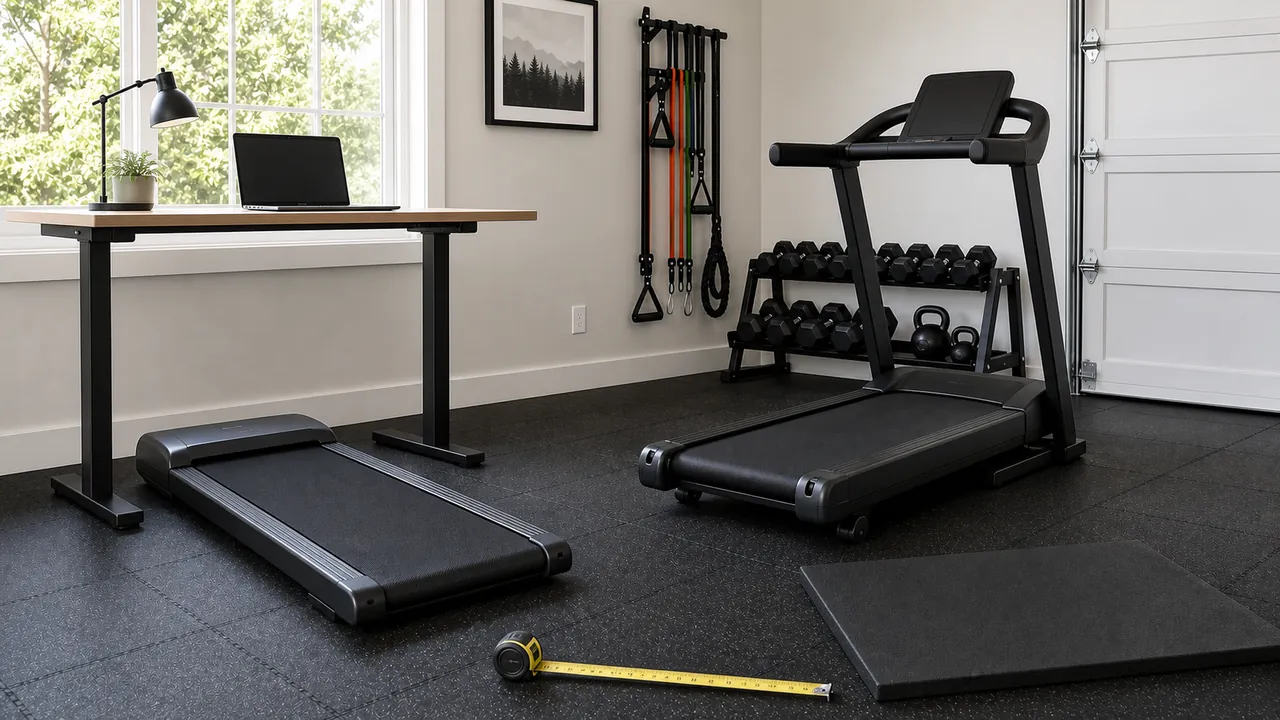
Pick the category first: apartment walking, apartment running, treadmill desk, garage/home gym running, or premium connected classes. Then measure the operating room, not the folded footprint. The unbranded header scene is AI-generated, not a product test photo.
The best home treadmill is not the one with the biggest screen or the largest horsepower number. It is the one that fits your training, your floor plan, your noise constraints, your maintenance tolerance, and your safety obligations.
We checked current manufacturer pages, manuals, written warranty terms, and major retailer listings on . We did not run on these machines or measure their noise, cushioning, or long-term stability. Verify the exact manual, electrical requirements, delivery service, warranty for your market, and the label on the machine before ordering.
Fast answer
If you want one conventional home treadmill for running and walking, start your shortlist with the Horizon 7.0 AT and Sole F80. If you want a treadmill-desk base, do not buy a running treadmill; start with the current LifeSpan TR5000B Pro+ GlowUp. If you live in an apartment, the question is not only "will it fold?" It is "can I keep operating clearance, control vibration, route delivery, and use it without turning every run into a building issue?"
The simplest bad purchase pattern is this: a buyer sees "folding treadmill," misses the actual operating footprint, ignores the rear clearance in the manual, runs hard on a lightweight frame, then discovers that the belt is too short, the deck shakes, the fan is useless, the screen requires a subscription, and the neighbors can hear the footstrike.
New to treadmill specs? The glossary notes translate belt size, clearance, motor wording, step-up height, delivery terms, and subscription language into what to measure or verify before ordering.
Plain-English treadmill spec glossary
Use this layer when you are buying for a household, apartment, spouse, parent, or beginner and do not already speak equipment-spec shorthand.
Running surface, belt size, and deck
Plain English: the belt is the moving surface; the deck supports it. Why it matters in a home: short belts can feel cramped for running even when the motor is fast. Measure/verify: protect about 20 x 60 in for running and treat 22 in width as extra lateral margin. Often misunderstood: top speed does not make a compact belt a running deck.
Deck cushioning
Plain English: the feel of the deck under footstrike. Why it matters: comfort, noise, and fatigue depend on more than the label. Measure/verify: try the machine at your real speed if cushioning is the reason you are buying. Often misunderstood: specs alone cannot prove superior cushioning.
Motor CHP, continuous horsepower, and peak horsepower
Plain English: CHP is meant to describe sustained output; peak HP is a short burst-style claim. Why it matters: running use needs more conservative interpretation than walking. Measure/verify: read the exact manufacturer wording and do not compare CHP and peak HP as the same measurement. Often misunderstood: a bigger number does not outrank deck size, frame weight, or serviceability.
Speed range, incline, and decline
Plain English: speed is belt pace; incline/decline changes slope. Why it matters: incline can add training load without high speed, but it also affects ceiling and stability. Measure/verify: test controls while moving and check whether incline changes headroom. Often misunderstood: desk treadmills do not need running speed or incline.
Operating footprint and folded footprint
Plain English: operating footprint is the space used when ready to run; folded footprint is storage space. Why it matters: the folded size does not tell you whether it is safe to use. Measure/verify: measure full room length and width, then add rear and side clearance. Often misunderstood: folding solves storage, not the fall zone.
Rear, side, and ceiling clearance
Plain English: empty space behind, beside, and above the treadmill. Why it matters: rear clearance is part of the fall zone; ceiling depends on user height, step-up, bounce, and incline. Measure/verify: use the manual when available; otherwise treat assumptions as screening only. Often misunderstood: a room can fit the machine but fail the safety rectangle.
Step-up height
Plain English: how high your feet are above the floor while using the deck. Why it matters: basements, tall users, and incline workouts can run out of headroom. Measure/verify: add user height, step-up height, and a buffer before ordering. Often misunderstood: low folded height is not the same as low step-up.
Product weight, user capacity, and capacity margin
Plain English: product weight is the machine; user capacity is the published max user weight; margin is the difference. Why it matters: moving, floor planning, stability, and running near the limit are different problems. Measure/verify: compare user weight to published capacity and keep more margin for running. Often misunderstood: capacity is not a comfort, durability, or safety guarantee.
Dedicated circuit, grounded outlet, surge suppressor, and extension cords
Plain English: electrical rules tell you how the treadmill should be powered. Why it matters: some brands require direct wall connection or specific surge protection. Measure/verify: read the manual and inspect the intended outlet before delivery. Often misunderstood: garage or bedroom convenience does not override power instructions.
Safety key, child lock, and household rules
Plain English: controls that stop or lock the treadmill are only part of safety. Why it matters: rear clearance, unplugging, key storage, and child/pet rules matter every day. Measure/verify: confirm emergency stop behavior and access-control steps. Often misunderstood: a safety key does not make poor placement safe.
Manual mode and subscription ecosystem
Plain English: manual mode is what works without paid classes or app features. Why it matters: connected treadmills can lose value if you dislike the subscription. Measure/verify: confirm what works without a paid membership before buying. Often misunderstood: a great screen is not useful if the household will not keep paying.
Walking pad and under-desk treadmill
Plain English: compact low-speed machines for walking, storage, and workday steps. Why it matters: they solve a different job than running treadmills. Measure/verify: check desk height, step-up, speed range, and belt size. Often misunderstood: higher top speed does not prove running suitability.
Lubrication, belt alignment, and deck maintenance
Plain English: routine care that keeps the belt and deck moving correctly. Why it matters: neglect can raise noise, wear, and service problems. Measure/verify: read the manual before buying and decide who will do the maintenance. Often misunderstood: maintenance is ownership cost, not an optional hobby.
Frame, motor, parts, labor, and wear-item warranty
Plain English: warranty fields cover different things for different periods. Why it matters: long frame coverage may not cover labor, deck, belt, or wear items. Measure/verify: read frame, motor, deck, parts, labor, exclusions, and in-home service terms. Often misunderstood: "lifetime frame" is not a whole-machine warranty.
Room-of-choice, curbside delivery, and return pickup
Plain English: delivery terms decide where the box goes and how returns work. Why it matters: a 274 lb or 460 lb treadmill can be unrealistic to move or return alone. Measure/verify: door width, stairs, elevator, turns, assembly, haul-away, and pickup terms. Often misunderstood: free delivery may still mean curbside only.
Apartment note: A folding treadmill can still be a bad apartment treadmill. Check operating footprint, rear clearance, floor vibration, lease rules, quiet hours, delivery path, and return pickup terms before ordering.
Delivery note: Product weight is not just a spec. It affects stairs, tight turns, room-of-choice delivery, assembly, and whether a return is realistic.
Safety note: Placement, rear clearance, key storage, unplugging habits, and child/pet rules are part of the purchase, not afterthoughts.
Match the treadmill to the home
Start with the use case, not the product category. "Home treadmill" can mean four very different machines: a desk treadmill for low-speed workdays, a compact walking pad for small apartments, a folding running treadmill for mixed training, or a heavy premium platform for a dedicated gym space. Their specs overlap less than marketing pages imply.
Apartment buyer
For an apartment, your first filter is not horsepower. It is the floor assembly, your lease or HOA rules, the time of day you train, and whether you can preserve a safe fall zone behind the deck. A compact treadmill that technically fits against a wall may still be a bad apartment machine if the manual requires substantial rear clearance or if every footstrike travels through a timber floor.
Measure before ordering: draw the operating footprint plus rear and side clearance on the floor with tape. If that rectangle blocks normal room use, folding storage does not solve the purchase.
The ProForm Carbon TLX manual, for example, tells owners to place the treadmill on a level surface with at least 8 ft of clearance behind and 2 ft on each side, and to place a mat under it to protect the floor or carpet. That manual also says children under 16 and pets should be kept away, the safety clip should be worn, and the machine should not be left unattended while running. Those are not tiny legal details; they are purchase constraints.
House or garage gym buyer
If you own the space and can dedicate a bay, you can choose a heavier machine more rationally. The Sole F80 is 274 lb and 82.5 in long when assembled, according to Sole. The Peloton Tread+ is 460 lb, 75 in long, and 37 in wide, according to Peloton. That extra mass can be a stability advantage for running, but it also changes delivery, moving, floor protection, and "can I ever rearrange this room?" decisions.
Desk treadmill buyer
A desk treadmill is a productivity tool first and a fitness tool second. LifeSpan's current TR5000B Pro+ GlowUp is published at 0.4-4.0 mph with a 20 in x 48.43 in belt and no incline. LifeSpan says incline walking while working takes the body out of a neutral position. That is the right product logic: low-speed repeatable walking, not heroic workouts during calls.
Shared household buyer
For shared homes, safety and friction matter. A treadmill that several people can start quickly, stop clearly, and use without fighting a subscription has an advantage. So does a machine with understandable controls. The TUV SUD treadmill certification page describes treadmill safety testing as related to stationary fitness equipment standards for users age 13 and above, while Peloton lists age minimum 16+ on its Tread pages. Do not treat a treadmill like passive furniture around children.
Choose by room and training type
Use this scoring rubric before looking at individual models. It keeps the purchase grounded in the real job you need the machine to do.
GarageGymPower scoring rubric
Interpretation: a desk walker should weight space, height, and noise more heavily. A runner should weight deck size, stability, speed/incline, and serviceability more heavily. A buyer in a shared apartment should make safety and noise gatekeeping criteria, not tie-breakers.
What matters most for each home
| Use case | Must-have | Nice-to-have | Usually overvalued | Best shortlist direction |
|---|---|---|---|---|
| Apartment walking | Low speed control, low step-up, easy storage, conservative clearance | Quiet motor claim, remote control, easy wheels | 12 mph top speed | LifeSpan TR5000B Pro+, WalkingPad C2, careful compact full-size only if noise test passes |
| Apartment running | 20 in x 60 in deck, stable frame, safe fall zone, neighbor test | Folding deck, quick speed controls, mat | Large screen before vibration control | Horizon 7.0 AT, ProForm Carbon TLX, Peloton Tread if subscription is acceptable |
| Garage gym running | Frame stability, wide belt, serviceable parts, warranty clarity | Decline, fan, app connectivity | Thin folded footprint | Sole F80, Horizon 7.0 AT/7.4 AT, NordicTrack 1750, Peloton Tread+ |
| Treadmill desk | Low-profile base, 0.4-4 mph control, desk compatibility | Step counter, safety pause, low product weight | Incline, running speed | LifeSpan TR5000B Pro+, WalkingPad C2 |
Comparison table: real models and published specs
The table below mixes conventional treadmills, premium connected machines, and compact walking units because home buyers often compare them incorrectly. Use the "best fit" column first, then the belt and footprint columns. Specs change, so verify the current product page and manual before purchase.
Source hierarchy: manufacturer page/manual first, retailer specs only when manufacturer specs were incomplete.
| Model | Best fit | Belt / running area | Footprint | Speed / incline | Capacity / weight | What we checked |
|---|---|---|---|---|---|---|
| Horizon 7.0 AT runnervalue |
Conventional first shortlist for running and interval walking without a giant built-in screen. | 20 in x 60 in | 76 in L x 35 in W x 67 in H | 0.5-12 mph, 0-15 percent incline | 325 lb user capacity, 277 lb product weight | Current manufacturer page |
| Sole F80 home gymsturdy |
Sturdy folding home-gym choice when you have the floor area and want published warranty clarity. | 22 in x 60 in | 82.5 in L x 38 in W x 66 in H; folded 45 in L x 38 in W x 71.5 in H | 0.5-12 mph, 15 incline levels | 350 lb user capacity, 274 lb item weight | Current manufacturer pageheavy delivery |
| NordicTrack Commercial 1750 connectedincline/decline |
Connected iFIT-style training if you want a large screen and decline, and accept ecosystem cost. | 22 in x 60 in | 77.3 in L x 37 in W x 59.5 in H | 0-12 mph, -3 to 12 percent incline/decline | 400 lb user capacity; in-box weight listed at 311.5 lb by distributor | Current brand page; dimensions need seller confirmationsubscription ecosystem |
| ProForm Carbon TLX budget runnerfolding |
Lower-cost full-size deck direction for walking/jogging/running, with iFIT caveats. | 20 in x 60 in | 74.3 in L x 35.1 in W x 59.1 in H | 0-12 mph, 0-12 percent incline | 300 lb capacity from manual; weight reported by secondary sources as 249 lb in-box | Current product page and manualsubscription ecosystem |
| ProForm Carbon Pro 2000 connectedmidrange |
More screen-forward ProForm option with similar running-deck logic. | 20 in x 60 in from retailer/secondary specs | 73.2 in L x 34.6 in W; height varies by source around 60.6 in | 0-12 mph, 0-12 percent incline | 350 lb user capacity from Lowe's product specs | Current manufacturer pagesubscription ecosystem |
| Peloton Tread classespremium |
Premium guided-class treadmill for households already bought into Peloton or willing to pay for content. | 59 in L x 20 in W | 68 in L x 33 in W x 65 in H; compact 6 ft x 3 ft footprint claim | 1-12.5 mph, 0-12.5 percent incline | 105-300 lb user range, 286 lb total weight | Current manufacturer pagesubscription ecosystem |
| Peloton Cross Training Tread+ slat beltpremium |
High-end slat-belt direction for dedicated space, budget, and strict household safety controls. | 67 in L x 20 in W, 59 slats | 75 in L x 37 in W x 70 in H; 7 ft x 3 ft footprint claim | 1-12.5 mph, 0-15 percent incline, Free Mode | 105-300 lb user range, 460 lb total weight | Current manufacturer pageheavy deliverysafety diligence |
| LifeSpan TR5000B Pro+ GlowUp deskwalking |
Desk walking and workday steps, not running or incline workouts. | 20 in W x 48.43 in L | 60.63 in L x 27.95 in W x 7.25 in H | 0.4-4.0 mph, no incline | 400 lb capacity, 84.13 lb treadmill weight | Current manufacturer pagecompact walking only |
| WalkingPad C2 compactwalking |
Small-space walking where storage matters more than running. | 400 mm belt width; walking-only geometry | 1445 x 518 x 125 mm unfolded; 825 x 518 x 136 mm folded | 0.5-6 km/h | 100 kg max load, 25 kg net weight | Current manufacturer pagecompact walking only |
| WalkingPad X21 compactjogging limit |
Compact foldable treadmill where brief jogging speed matters, but belt length is still short for many runners. | 460 x 1210 mm running area | 1419 x 711 x 1053 mm unfolded; 1007 x 711 x 225 mm folded | 1-12 km/h | 110 kg max load, 37 kg net weight | Current manufacturer pagecompact walking only |
Recommendations by the job they need to do
These are lane choices, not a single best-to-worst ranking. Availability and written terms were checked on July 14, 2026; noise, deck feel, and long-term durability still need a real trial or a workable return path.
Product details to verify before delivery
This table separates machine construction and exact-model origin from brand history. A brand's home base does not establish where a treadmill was made; where the current model page does not say, check the physical country-of-origin label before accepting delivery.
| Model | Useful size and weight | Construction that affects ownership | Where this exact model is made | Brand context | Written protection |
|---|---|---|---|---|---|
| Horizon 7.0 AT | 76 x 35 x 67 in; 277 lb; 20 x 60 in deck | Folding performance frame and three-zone cushioned deck; frame material not specified on the product page. | Not disclosed for this exact model; check the machine label. | Horizon was established by Johnson Health Tech in 1998 and is its home-fitness brand; US operation is in Wisconsin. | US home use: lifetime frame and motor, 3 years parts, 1 year labor; read coverage exclusions. |
| Sole F80 | 82.5 x 38 x 66 in; 274 lb; 8 in step-up | Folding 22 x 60 in deck with 2.36 in rollers; exact frame and belt materials are not stated. | Not disclosed for this exact model; Salt Lake City is the company base, not origin proof. | SOLE is based in Salt Lake City and says its equipment was originally engineered for hotel use; brand founding year was not verified. | US residential: lifetime frame/motor; 3 years deck, parts, wear items; 1 year labor; 90 days cosmetic. |
| NordicTrack Commercial 1750 | Current seller dimensions need confirmation; 22 x 60 in deck in current comparison records. | Folding cushioned running deck with 16 in pivoting touchscreen; the manufacturer does not state the material composition. | Not verified for the current exact model; check the label on delivery. | NordicTrack began in Minnesota in 1975 with the ski machine and is now an iFIT connected-fitness brand. | Current US series terms: lifetime motor, 10 years frame, 2 years parts, 1 year tablet and labor/repairs. |
| ProForm Carbon TLX | 74.3 x 35.1 x 59.1 in; published item weight not verified | Folding 20 x 60 in ProShox-cushioned deck; the manufacturer does not state the material composition. | Not verified for the exact current unit; a manual's print location is not manufacturing proof. | ProForm is an iFIT home-fitness brand; parent-company roots date to 1977, while a separate brand founding year was not verified. | Current exact component schedule was not consistently stated; request the written US warranty before paying. |
| ProForm Carbon Pro 2000 | 73.2 x 34.6 x 60.6 in; 249 lb in-box, not item weight | Folding 20 x 60 in ProShox-cushioned deck and 10 in touchscreen; materials not specified. | Not disclosed for model PFTL10925; check the physical label. | ProForm is an iFIT home-fitness brand; parent-company roots date to 1977. | The current page routes buyers to iFIT warranty terms; confirm exact frame, parts, tablet, and labor periods in writing. |
| Peloton Tread | 68 x 33 x 65 in; about 286-291 lb by current locale; 8 in step-up | Carbon-steel platform and rails; woven-nylon belt with textured PVC top; polycarbonate tray. | Not disclosed for this exact model; New York headquarters is not manufacturing evidence. | Peloton was founded in 2012 and is headquartered in New York City; known for connected equipment and classes. | US limited warranty: 12 months for most components/touchscreen, 3 years motor and belt, 5 years frame; location limits apply. |
| Peloton Cross Training Tread+ | 75 x 37 x 70 in; 460 lb; 11 in step-up | Rubberized belt made from 59 individual slats; powered or foot-driven Free Mode. | Not disclosed for this exact model; check its product label. | Peloton was founded in 2012 in New York City and combines connected fitness hardware, software, and classes. | Current US product page states 12-month limited coverage for touchscreen, frame, motor, belt, and most components; verify terms. |
| LifeSpan TR5000B Pro+ GlowUp | 60.63 x 27.95 x 7.25 in; 84.13 lb; 4.6 in belt step-up | 0.7 in phenolic reversible deck, anodized-aluminum rails, heavier-duty belt, six compression shocks. | Not disclosed for this exact model; check the base label. | LifeSpan focuses on workplace-wellness and under-desk equipment; official base and establishment year were not verified. | US page: 10 years frame, 2 years parts, 1 year labor; confirm home versus workplace-use scope. |
| WalkingPad C2 | 56.9 x 20.4 x 4.9 in open; 32.5 x 20.4 x 5.4 in folded; 55 lb | Half-folding base with EVA and PET shock-absorption layers; fully assembled. | Not verified for this exact model; KingSmith's Beijing base is not origin proof. | KingSmith was founded in Beijing in 2015 and launched WalkingPad through crowdfunding in 2018. | US store: 1-year warranty with optional extension; buyer-paid return shipping can apply after 30 days. |
| WalkingPad X21 | 55.8 x 27.9 x 41.4 in open; 39.6 x 27.9 x 8.8 in folded; 81 lb | Double-fold frame with EVA and PET shock absorption, fixed handrail, safety key, and transport wheels. | Not verified for this exact model; check the treadmill label. | KingSmith was founded in Beijing in 2015 and specializes in compact folding fitness equipment. | US store: 1-year warranty with optional extension; confirm shipping responsibility for service. |
Belt-size vs use-case chart
Use this before comparing screens, fans, or app ecosystems. Belt size separates desk walking, compact walking, jogging caution, and full running more clearly than most marketing categories.
How to read this: start with the band that matches the intended use. A product can appear in a faster marketing category and still be a poor running fit if belt length, frame mass, and safety rails do not match the job.
Under-desk / workday walking
Compact walking and jogging caution
20 x 59-60 in running baseline
22 in width comfort margin
How to read this chart
The bands are use-case screens, not safety guarantees. A 20 x 60 in deck is a practical starting point for many home runners; a 22 in width adds lateral margin. Compact walking pads belong in a different category even when a product page advertises a higher top speed.
| Model | Belt / running area | Use-case band | Product weight signal | Buyer meaning |
|---|---|---|---|---|
| Horizon 7.0 AT | 20 x 60 in | Running baseline | 277 lb | Conventional running shortlist if room and clearance pass. |
| Sole F80 | 22 x 60 in | 22 in width margin | 274 lb | More lateral margin with a larger footprint. |
| NordicTrack Commercial 1750 | 22 x 60 in fallback | 22 in width margin | 311.5 lb in-box | Connected running category; verify official specs/manual. |
| ProForm Carbon TLX | 20 x 60 in | Running baseline | 249 lb in-box fallback | Budget full-size direction with iFIT caveats. |
| ProForm Carbon Pro 2000 | 20 x 60 in fallback | Running baseline | not fully verified | Verify manual and exact dimensions before choosing. |
| Peloton Tread | 20 x 59 in | Running baseline | 286 lb | Premium class direction, not a space shortcut. |
| Peloton Tread+ | 20 x 67 in slat belt | Running baseline / heavy dedicated room | 460 lb | Heavy delivery and household safety gate. |
| LifeSpan TR5000B Pro+ GlowUp | 20 x 48.43 in | Under-desk walking | 84.13 lb | Desk walking, not running. |
| WalkingPad C2 | 400 mm belt width | Compact walking | 25 kg / 55 lb | Storage-first walking pad. |
| WalkingPad X21 | 460 x 1210 mm | Compact jogging caution | 37 kg / 81 lb | Top speed does not prove running suitability. |
Technical buying factors that actually matter
Belt size and deck length
For running, belt length is the first spec I would protect. A 60 in belt is common among full-size home runners: Horizon 7.0 AT is 20 in x 60 in, Sole F80 is 22 in x 60 in, and NordicTrack Commercial 1750 is listed at 22 in x 60 in by Johnson Fitness. Peloton Tread is slightly shorter at 59 in x 20 in. A 48.43 in under-desk belt, like the LifeSpan TR5000B Pro+ GlowUp, is rational for walking while working but not for normal running stride length.
Width is the second comfort spec. A 20 in belt can work for many home runners. A 22 in belt gives more lateral margin, especially for larger users, tired intervals, or anyone who tends to drift on the deck. The tradeoff is footprint: the Sole F80's 38 in width is less apartment-friendly than a narrower machine.
Motor ratings: CHP, peak HP, and marketing confusion
Motor claims are useful but easy to overread. Continuous horsepower is more meaningful than peak horsepower, but published motor numbers still do not tell you cooling, controller behavior, belt friction, deck condition, or how the motor behaves at heavier user weights. LifeSpan even shows both "3.5 HP peak brushless motor" and a "3.0 HP continuous-duty motor" statement on the same product page area, which is a good reminder to read the exact wording.
For runners, do not buy a treadmill because it has a bigger motor number while ignoring deck size, frame mass, rollers, warranty, and serviceability. For desk walking, motor smoothness at low speed and noise under workday use matter more than a top-speed horsepower claim.
Speed, incline, and decline
Most conventional home treadmills in the comparison reach about 12 mph. That is enough for most home users. Incline has a bigger practical effect for walkers because it increases training load at lower speeds. Horizon lists 0-15 percent incline for the 7.0 AT, Peloton Tread lists 0-12.5 percent, Peloton Tread+ lists 0-15 percent, and the NordicTrack 1750 listing includes -3 to 12 percent incline/decline.
Desk treadmills are different. LifeSpan lists no incline on the TR5000B Pro+ GlowUp and says incline walking while working is not recommended. That is a useful constraint, not a missing feature. A desk treadmill should keep posture manageable while you type, read, and speak.
User weight capacity and de-rating
Published user capacity is a hard number, but it is not a complete stability rating. Horizon lists 325 lb for the 7.0 AT. Sole lists 350 lb for the F80. Peloton lists a user weight range of 105-300 lb for both Tread and Tread+. KingSmith lists 100 kg for the C2 and 110 kg for the X21. LifeSpan lists 400 lb for the TR5000B Pro+ GlowUp.
My buyer interpretation: leave margin if you plan to run, not just walk. Running multiplies impact and frame movement compared with steady walking. A user near the published maximum should be more conservative about deck width, frame weight, service access, and warranty terms.
Machine weight, moving, and delivery
Machine weight is a real ownership factor. An 84.13 lb under-desk base can be moved in a way a 274 lb full-size treadmill cannot. A 460 lb Peloton Tread+ may make sense in a dedicated room, but it is a serious delivery and floor-planning object. Before buying, trace the route from curb to final location: stairs, turns, door widths, ceiling, outlet, and whether the final room can preserve operating clearance.
Noise and vibration
Published dB claims are often incomplete and the current pages do not provide comparable test conditions across this set. They do not include your footstrike, shoe choice, body weight, floor type, belt condition, room acoustics, or downstairs neighbor sensitivity. A mat can reduce some mechanical vibration and protect the floor, but it cannot turn a hard run on a flexible floor into silence.
Folding and storage
Folding solves storage, not operation. The Sole F80 folds from an 82.5 in operating length to a 45 in folded length, but it still needs its full operating footprint while in use. KingSmith's C2 and X21 are different: their folding geometry is central to small-space storage. That may be perfect for walking, but the compact belt and lighter frame create real performance limits.
Step-up height and ceiling
Step-up height matters for low ceilings, basement rooms, and taller users. Sole lists 8 in for the F80. Peloton lists 8 in for Tread and 11 in for Tread+. LifeSpan lists 4.6 in belt step-up and 5.25 in side rail height. Add your body height, running bounce, incline lift, and ceiling fixtures. Do not assume a treadmill that fits horizontally also fits vertically.
Power, outlets, and surge protection
Electrical requirements are not interchangeable. Peloton lists a 15A dedicated circuit and says to plug directly into the wall socket, not an extension cord. The ProForm Carbon TLX manual tells users to use a surge suppressor meeting specified requirements and a 120V circuit capable of carrying at least 15 amps. If your treadmill will live in a garage, basement, or apartment bedroom, check the outlet before delivery.
Safety design and household behavior
Treadmills are moving belts with pinch and fall risks. The CPSC's 2021 Peloton Tread+ recall page reported one child death and more than 70 incidents. That does not mean every current treadmill is unsafe; it means a serious buyer should treat access control as part of the purchase. Remove the key, unplug when not in use where appropriate, keep children and pets away, and preserve the rear fall zone.
Subscriptions and locked value
Connected treadmills can be excellent if you actually want coached classes. Peloton clearly states the hardware, screen, speed, incline, and membership requirements on its product pages. ProForm and NordicTrack models can be attractive for iFIT-style training. The risk is buying a treadmill for the screen, then resenting the ongoing subscription or losing features if you stop paying. Decide before purchase whether the treadmill must be good in manual mode.
Warranty and service
Warranty terms are more meaningful than slogans. Sole publishes lifetime frame and motor coverage for the F80, with deck, parts, and wear items at 3 years and labor at 1 year for residential use. Peloton's current terms differ by Tread model and component. LifeSpan lists 10 years frame, 2 years parts, and 1 year labor for the TR5000B Pro+ GlowUp. Read exclusions, labor rules, in-home service availability, and whether warranty coverage changes with location or use.
Walking pad vs treadmill
Apartment treadmill reality check
Measure the room, then measure the building problem. A lease or HOA rule, timber floor, downstairs bedroom, quiet-hours policy, or narrow stair turn can matter more than the treadmill's published speed range.
- Lease and quiet hours: confirm whether motorized exercise equipment is allowed and when it can be used.
- Floor construction: concrete over slab is different from a flexible upper-floor assembly.
- Noise source: a quiet motor claim does not include footstrike, belt slap, console rattles, or your shoes.
- Fall zone: do not trade rear clearance for apartment convenience.
Delivery path checklist
Garage gym considerations
A garage treadmill has different failure modes than a living-room treadmill. Temperature swings, humidity, dust, grit from shoes, uneven floors, extension-cord temptation, and storage clutter all raise ownership friction.
- Use a level surface and a mat that protects the floor without making the deck unstable.
- Keep dust and grit off the belt and rollers; cleaning is maintenance, not cosmetics.
- Verify the outlet and circuit before delivery. Do not assume an extension cord is allowed.
- Check warranty language if the garage is not climate controlled.
Maintenance cost and friction
The cheapest treadmill is not cheap if it is annoying to keep aligned, lubricated, cleaned, and serviced. Read the manual before buying for belt alignment, lubrication schedule, cleaning rules, surge protection, and whether service is realistic in your area.
Budget for the boring parts: mat, lubricant if required, belt/deck wear, possible labor, and the time cost of moving a heavy machine if it has to be returned.
Quick room fit checker
This is not a replacement for the manufacturer's manual. It is a conservative screening tool using published operating footprints and clear-room assumptions. Full-size treadmills default to 8 ft rear clearance and 2 ft each side because that matches the ProForm manual guidance found during research. Where a manufacturer clearance was not found, the table says so and uses a conservative screening assumption that must be verified before purchase.
The visual is a screening plan, not an architectural drawing. Use the table for exact assumptions.
Ceiling check uses user height + step-up height + a 6 in running/headroom buffer where step-up data exists. Folded dimensions are not operating dimensions.
| Manual result | Meaning | Before ordering |
|---|---|---|
| Room exceeds required clear room by 12+ in length and width | Likely workable on paper. | Still verify outlet, delivery path, rear fall zone, and exact manual. |
| Room passes but by less than 12 in | Tight; verify exact clearance. | Tape the rectangle on the floor and check surrounding furniture and doors. |
| Room is short in length, width, or ceiling | Does not fit with conservative clearance. | Choose a smaller category or a different room. |
| Manual clearance or step-up is missing | Missing manual field; verify before purchase. | Ask the manufacturer or seller for current manual guidance. |
| Model | Operating footprint | Rear clearance | Side clearance | Required clear room | Step-up / ceiling note | Product weight / delivery risk | What to verify |
|---|---|---|---|---|---|---|---|
| Horizon 7.0 AT | 76 in L x 35 in W | 96 in | 24 in each side | 172 in L x 83 in W | Step-up not found; verify manual | 277 lb | Manufacturer dimensions; use the conservative clearance only until the exact manual is checked. |
| Sole F80 | 82.5 in L x 38 in W | 96 in | 24 in each side | 179 in L x 86 in W | 8 in step-up; add user height + 6 in buffer | 274 lb | Manufacturer size and step-up; check exact manual clearance for your unit. |
| NordicTrack Commercial 1750 | 77.3 in L x 37 in W | 96 in | 24 in each side | 174 in L x 85 in W | Step-up not found; verify manual | 311.5 lb in-box | Current assembled dimensions, item weight, step-up, and exact manual clearance. |
| ProForm Carbon TLX | 74.3 in L x 35.1 in W | 96 in | 24 in each side | 171 in L x 84 in W | Step-up not found; verify manual | Published item weight not verified | Manual clearance is available; confirm item and shipping weight with the seller. |
| ProForm Carbon Pro 2000 | 73.2 in L x 34.6 in W | 96 in | 24 in each side | 170 in L x 83 in W | Step-up not found; verify manual | 249 lb in-box | The official figure is in-box weight; confirm item weight, step-up, and manual clearance. |
| Peloton Tread | 68 in L x 33 in W | 79 in | 24 in each side | 147 in L x 81 in W | 8 in step-up; Peloton asks for ceiling 20 in above user height | about 286-291 lb by current locale | Use Peloton's current placement guide and confirm the delivered market version. |
| Peloton Cross Training Tread+ | 75 in L x 37 in W | 96 in | 24 in each side | 171 in L x 85 in W | 11 in step-up; add user height + 6 in buffer | 460 lb | Confirm current placement instructions, final-room service, and access controls. |
| LifeSpan TR5000B Pro+ GlowUp | 60.63 in L x 27.95 in W | 48 in | 12 in each side | 109 in L x 52 in W | 4.6 in step-up; add user height + 6 in buffer | 84.13 lb | Compact clearance is a screening assumption; check the current manual. |
| WalkingPad C2 | 56.9 in L x 20.4 in W | 36 in | 12 in each side | 93 in L x 45 in W | Step-up not found; verify manual | 25 kg / 55 lb | Compact clearance is a screening assumption; confirm it in the manual. |
| WalkingPad X21 | 55.8 in L x 27.9 in W | 72 in | 18 in each side | 128 in L x 64 in W | Step-up not found; verify manual | 37 kg / 81 lb | Compact clearance is a screening assumption; confirm step-up and fall zone. |
Ownership tools before checkout
These utilities use published specs and buyer-entered assumptions. They are screening aids, not safety guarantees or engineering sign-offs.
Capacity-margin checker
Published capacity margin is the difference between the manufacturer-listed capacity and the user's weight. It is not a comfort, durability, or safety guarantee.
Delivery-risk checklist generator
Use this before checkout, especially for heavy treadmills, apartments, basements, and upper-floor rooms.
Subscription-cost calculator
No current subscription prices are hard-coded here. Enter the current official monthly price yourself, then decide whether manual mode would still satisfy you.
Prompt before buying: if you cancel the membership, would the treadmill still be worth the floor space?
Warranty fields to verify
Warranty fields vary by model, component, purchaser, and market. Use these questions before treating a long headline term as a purchase advantage.
| Field | Why it matters | What the current pages show | Buyer action |
|---|---|---|---|
| Frame | Often longest term, but not the whole machine. | Explicit for Horizon, Sole, NordicTrack, Peloton, and LifeSpan; confirm the exact ProForm terms. | Read the current warranty PDF/page. |
| Motor | Important for long-term running use. | Explicit for Horizon, Sole, NordicTrack, and Peloton Tread; not separately stated for every model. | Confirm term and exclusions. |
| Deck / belt / wear items | Wear items can be excluded or shorter-term. | Sole and Peloton publish component terms; several brands group or omit these fields. | Ask whether belt/deck wear is covered. |
| Parts and labor | Labor and in-home service affect real repair cost. | Published periods differ; shipping and trip charges can still apply. | Check in-home service and shipping terms. |
| Use/location exclusions | Garage, commercial, or non-climate-controlled use may matter. | Terms depend on purchaser type, market, and where the machine remains. | Verify before garage or shared-building use. |
Manual and safety checks completed
This list shows what we found and what you still need to verify for the delivered model. Text carries the meaning; color is not required.
| Model or source | Manual found? | Clearance found? | Electrical rules found? | Maintenance/warranty found? | Safety source checked? |
|---|---|---|---|---|---|
| ProForm Carbon TLX | Manual found | Manual clearance found | 120V/15A surge guidance found | Warranty not complete here | Manual safety rules found |
| Peloton Tread / Tread+ | Product/support pages used | Placement guidance still verify | 15A dedicated circuit found | Limited warranty noted | CPSC Tread+ recall source checked |
| Horizon, Sole, NordicTrack, LifeSpan, KingSmith | Mixed/manuals incomplete | Conservative assumptions used where missing | Verify manual before purchase | Warranty fields vary | General treadmill safety context used |
How to try the treadmill before buying
If you can try a treadmill in a store or showroom, do not spend the whole time scrolling the console. Test the parts the spec sheet cannot prove.
- Walk, jog, and run at your actual speeds. A deck can feel stable at 3 mph and nervous at 7.5 mph.
- Use the incline while moving. Listen for strain, speed changes, rattles, and whether controls remain easy to hit.
- Drift test. Run tired for a minute and notice whether the belt width gives enough side margin.
- Emergency stop test. Know exactly how the clip, stop button, and rails behave.
- Mount and dismount. Check step-up height, side rail grip, and whether the console blocks natural posture.
- Noise sanity check. Ignore the store's ambient noise. Listen for thumps, squeaks, motor pitch, fan noise, and console rattles.
- Manual mode test. Confirm you can start a workout without a subscription, app login, or account friction if that matters to you.
- Fold and move it. If "folding" is part of your plan, operate the latch and wheels yourself.
What to bring
Bring the shoes you will use, your room measurements, your ceiling height, and a note with your target speeds. If the treadmill is for an apartment, record a short video from beside and behind the machine so you can judge visible bounce and console shake later.
Red flags
- No real belt dimensions. "Large running area" is not enough. You need width and length.
- Peak horsepower only. Peak HP without continuous-duty context is weak evidence.
- Folded dimensions treated as operating dimensions. Folding does not remove the need for rear clearance.
- Very high capacity on an ultra-light frame. Capacity claims should be checked against frame mass, warranty, and real user feedback.
- No accessible manual before purchase. Manuals reveal clearance, electrical, maintenance, and safety constraints that product pages often hide.
- Subscription-required core use. If manual mode is limited or buried, make sure you want that ecosystem.
- Apartment promise with no vibration evidence. A "quiet motor" does not mean quiet footstrike.
- Return logistics ignored. A heavy treadmill return can be expensive, slow, and physically difficult.
What specs do not tell you
Specs are necessary, but they do not tell you belt feel, shock absorption quality, console lag, rail comfort, incline motor smoothness, fan usefulness, deck heat under long runs, repair parts availability, or how the treadmill sounds in your room. They also cannot tell you whether you will actually enjoy the content ecosystem enough to keep paying for it.
Specs also do not settle safety. A treadmill can have a stop switch and still be dangerous if it is placed with no rear clearance, used around children, left keyed and powered on, or run barefoot. The machine and the room are one system.
Uncertain claim boundary
I would not rank these models by lowest-noise claims or superior cushioning from specs alone. Manufacturer noise data is inconsistent, and cushioning is subjective unless measured under controlled conditions. The honest recommendation is to shortlist by fit and published specs, then test sound and feel in the intended environment when possible.
Buyer checklist
- Measure the operating rectangle, not just storage space.
- Confirm rear and side clearance from the manual.
- Confirm ceiling clearance with incline and step-up height.
- Check delivery path, stairs, corners, and door widths.
- Choose belt length by use: desk walking, walking, jogging, or running.
- Leave capacity margin if you will run near the published user limit.
- Read warranty terms: frame, motor, deck, parts, labor, wear items.
- Decide whether subscriptions are optional or central to value.
- Plan maintenance: belt alignment, deck cleaning, lubrication if required.
- Define child and pet access rules before the treadmill arrives.
- Verify outlet, circuit, surge, and extension-cord restrictions.
- Keep the packaging and return window details until the first real test week is over.
Use this order before buying
If you are a serious home buyer and you want a practical shortlist, use this order:
First, decide the category. Desk walking, compact walking, running, and connected premium running are different categories. Do not let folding marketing blur them.
Second, protect the deck. For real running, start at 20 in x 60 in and prefer 22 in width if you have space, are larger, or value margin. For desk walking, a shorter belt is fine because speed and stride length are lower.
Third, make space and safety hard gates. If the treadmill cannot be placed with proper clearance, it is not a fit. If children or pets can access it casually, it is not a solved purchase.
Fourth, choose the ownership model. A simple treadmill with clear warranty terms may be better for long-term home-gym use. A premium connected treadmill may be better if the content is what keeps you training. A compact walking pad may be best if consistency depends on convenience.
Finally, verify the weak evidence. Noise, cushioning, console friction, and stability are not fully knowable from specs. If those are the reason you are buying, insist on a trial, return path, or in-person test.
FAQ
What size treadmill do I need for running?
Use 20 x 60 in as the practical starting point for most running. A 22 in width gives more lateral margin if the room can handle it.
Can I use a treadmill in an apartment?
Sometimes, but the hard questions are lease rules, floor construction, vibration, delivery path, rear clearance, and quiet hours. Walking is easier to justify than running.
Is a walking pad good for running?
No for normal running. Walking pads are built around low-speed convenience, compact storage, and desk use. Do not treat top speed as proof of running suitability.
How much clearance does a treadmill need?
Check the exact manual. This guide uses 8 ft rear and 2 ft side clearance as a conservative full-size default because that appeared in ProForm manual guidance during research.
Do treadmills need a dedicated circuit?
Some brands specify direct wall connection or circuit requirements. Peloton publishes a 15A dedicated circuit requirement, while ProForm manual language specifies surge suppressor and 120V circuit details. Read the manual before delivery.
Is Peloton, NordicTrack, or iFIT usable without a subscription?
That depends on the model, current software, and what features you expect. Decide whether manual mode alone would still satisfy you before buying a screen-forward treadmill.
What treadmill belt length is enough?
Desk walking can work on shorter belts because speed and stride length are lower. Running usually deserves a 60 in belt unless you have tested the shorter deck at your actual pace.
Sources and notes
- Horizon Fitness: 7.0 AT Treadmill - current order status, deck, dimensions, weight, capacity, construction language, and warranty.
- Horizon Fitness: company background - Johnson Health Tech relationship and home-fitness focus.
- SOLE Fitness: F80 Treadmill - running surface, dimensions, item weight, capacity, rollers, and component warranty.
- SOLE Fitness: company background - Salt Lake City base and hotel-equipment origins.
- NordicTrack: Commercial 1750 - current in-stock status, screen, speed, slope range, and folding deck.
- NordicTrack: Commercial Series terms - current warranty and manual-mode summary.
- ProForm: Carbon TLX - current product identity and direct product context.
- ProForm Carbon TLX user's manual - clearance, safety, power, capacity, and maintenance guidance.
- ProForm: Carbon Pro 2000 - current in-stock status, PFTL10925 dimensions, in-box weight, belt, capacity, and features.
- Peloton: Tread - current dimensions, placement, membership, and component warranty.
- Peloton: Tread setup and safety - clearance, safety key, Tread Lock, and household access rules.
- Peloton: Tread+ - current dimensions, rubberized slat belt, weight, speed, incline, power, and warranty statement.
- Peloton: company background - 2012 founding and connected-fitness mission.
- LifeSpan: TR5000B Pro+ GlowUp - current orderability, size, weight, construction, capacity, and warranty.
- WalkingPad: C2 - current orderability, dimensions, weight, EVA/PET layers, capacity, and warranty.
- WalkingPad: X21 - current orderability, size, weight, construction, belt, and warranty.
- KingSmith: company background - 2015 Beijing founding and WalkingPad history.
- U.S. CPSC: Peloton Tread+ recall history - historical safety context, not a claim about the current model's condition.
- TUV SUD: treadmill certification context - third-party standards context.