Bar class before brand or PSI
Best Olympic Barbells for Home Gyms
Pick the shaft, knurl and sleeve system for the lifts you actually train, then prove it fits your rack and plates.
We checked current manufacturer specifications, direct-store orderability, warranty limits and visible exact-model review counts. We did not lift with, measure, drop or maintain these bars. Knurl feel, rotation, whip, noise, straightness and finish wear still need an in-person inspection.
Researched for home-gym lifters and household buyers.
Choose a mixed-use 28.5 mm bar when one bar must cover varied training. Choose 29 mm with center knurl for dedicated powerlifting, 15 kg/25 mm only when that geometry is wanted, and a 28 mm bearing bar for dedicated Olympic weightlifting.
- One mixed-use bar: REP Colorado Bar 20 kg (exact European variants showed 24-48 hour dispatch; the US page remained delayed)
- Squat, bench, deadlift: Rogue 45LB Ohio Power Bar
- 15 kg and 25 mm: Bella Bar 2.0
- Competition-oriented weightlifting: Rogue 28MM IWF bar
Avoid a general “Olympic bar” purchase if you have not separated powerlifting from the snatch and clean and jerk.
Verify before buying: current stock or regional ship date, inside rack width, J-cup clearance, plate width per side, collar width, floor/drop rules and finish-care conditions.
Compare the bar classesNumbers only matter in combination
Read a bar specification without ranking one number
Olympic plates
Plates with roughly 2-inch center holes that load onto rotating sleeves.
“Olympic” describes the plate interface; it does not make every bar a competition weightlifting bar.
Confirm plate bore, collar choice and sleeve diameter together.
A 7-foot Olympic bar can still be an economy, mixed-use or power bar.
20 kg, 45 lb and 15 kg
Published bar mass and competition-style category.
It changes the empty starting load, shaft diameter and often sleeve length.
Program with the actual stamped mass and choose 15 kg/25 mm only because it suits the lifter or sport.
15 kg does not mean junior or low quality; it is a distinct standard geometry.
Shaft diameter
The thickness of the gripped steel shaft: 25, 28, 28.5 or 29 mm here.
It interacts with hand fit, bar stiffness and lifting discipline.
Compare the intended competition or training style and try the diameter under the actual lifts.
Thinner is not automatically easier and thicker is not automatically stronger.
Knurl marks
Unknurled rings that help place hands for powerlifting or Olympic weightlifting.
Single or dual marks make different training references visible.
Match the markings to the lifts and federation rules you follow.
Dual marks do not make a mixed-use bar competition-certified for both sports.
Center knurl
A textured section in the middle of the shaft.
It can add contact in a back squat but also meets the shirt or skin in front-rack lifts.
Check whether the main training is squats and power lifts or repeated cleans.
Presence or absence is a use-case choice, not a universal quality sign.
Bushings and bearings
Internal parts that let sleeves rotate around the shaft.
Bushings suit many mixed and slow lifts; bearing systems target weightlifting rotation.
Buy bearings because the lifting discipline needs them, not because the word sounds premium.
The component name alone does not prove smoothness, noise or longevity.
Loadable sleeve length
The usable sleeve space for plates and a collar.
Thick bumper plates can fill a short sleeve before weight capacity becomes relevant.
Stack the actual plate widths plus collar width on paper for each side.
Total bar length does not tell you usable loading room.
Tensile strength
A steel material figure commonly stated in PSI.
It describes one shaft property, not the whole bar, warranty or safe dynamic load.
Use it only with geometry, intended use, construction and manufacturer terms.
The highest PSI does not automatically make the best home-gym bar.
How four unlike jobs replaced a flat ranking
We first split the category into mixed-use, powerlifting, 15 kg multipurpose and dedicated Olympic weightlifting. Exact manufacturer pages controlled specs and warranty wording. Current direct ordering plus visible exact-product review volume supplied a buyer-interest signal, never a quality verdict.
We excluded a Bells power bar because its live page showed “Unavailable” alongside cart copy. CAP and Body-Solid economy candidates stayed out because exact-model or decision-critical specifications were not clean enough for a primary recommendation. Specialty deadlift, squat and safety bars are outside this route.
Choose the row that matches training
Bar class comparison
| Bar | Geometry | Sleeves | Knurl and rotation | Buyer meaning |
|---|---|---|---|---|
| REP Colorado 20 kg | 28.5 mm; 86.6 in | 16.1 in loadable | Dual marks; no center; composite bushings | One-bar compromise for varied garage training. |
| Rogue Ohio Power 45 lb | 29 mm; 86.52 in | 16.25 in loadable | Power marks; center; bronze bushings | Dedicated big-three geometry. |
| Bella Bar 2.0 15 kg | 25 mm; 79.13 in | 13 in loadable | Dual marks; no center; bronze bushings | Lower empty mass and thinner shaft, with less plate room. |
| Rogue IWF 20 kg | 28 mm; 86.6 in | 16.25 in loadable | Olympic marks; center; 10 needle bearings | Dedicated, competition-oriented weightlifting bar. |
Recommendations by lifting job
REP Colorado Bar 20 kg: one mixed-use bar
Fit: varied squats, presses, pulls and some Olympic-lift practice where one bar must stay on the platform.
The 28.5 mm shaft, dual marks, no center knurl and bushing sleeves form a deliberate mixed-use package. Its 16.1-inch sleeves preserve useful loading room.
Advantage: covers more lifting styles without pretending to be a competition specialist.
Drawback: no center knurl for lifters who specifically want one in squats, and immediate US dispatch was unavailable when checked.
Avoid if: nearly all training follows one competitive discipline or you need an immediately shipped US bar.
Alternative: Ohio Power Bar for powerlifting or Rogue IWF bar for weightlifting.
The exact REP Europe page showed variants, Add to cart, 24-48 hour dispatch and 312 reviews. The separate US page remained delayed. Finish feel and rotation were not tested.
Rogue Ohio Power Bar: squat, bench and deadlift
Fit: a home powerlifting setup that wants a 29 mm shaft, power marks and center knurl.
The black-zinc 45 lb model has the geometry that changes this decision: 29 mm, center knurl, power marks, bronze bushings and 51.5 inches between sleeves.
Advantage: discipline-specific rack geometry with a long, visible direct-store record.
Drawback: center knurl and power-bar stiffness are poor matches for repeated cleans and snatches.
Avoid if: front-rack work and Olympic lifts dominate.
Alternative: Colorado for mixed use.
Exact specs, USA manufacture, add-to-cart and 732 reviews were visible. Knurl comfort remains personal.
Bella Bar 2.0: choose 15 kg and 25 mm deliberately
Fit: a lifter or household specifically choosing the 15 kg, 25 mm standard while retaining normal rack spacing.
It is not a smaller “beginner bar.” Its 15 kg mass, 25 mm shaft, dual marks and no center knurl define a distinct multipurpose standard.
Advantage: lower empty mass and thinner grip with rackable 51.875-inch shaft spacing.
Drawback: 13-inch sleeves lose plate room sooner with thick bumpers.
Avoid if: the buyer needs 20 kg competition practice or long sleeves.
Alternative: Colorado 20 kg.
Exact page showed ordering, 242 reviews, USA manufacture and complete geometry. Hand fit was not tested.
Rogue 28MM IWF bar: dedicated Olympic weightlifting
Fit: the snatch and clean and jerk with a 20 kg, 28 mm, IWF-approved bearing bar.
This exact bright-zinc version uses Olympic marks, a center knurl and five needle bearings per sleeve. Those are specialist choices, not generic upgrades.
Advantage: competition-oriented exact geometry and published IWF status.
Drawback: premium cost and zinc care for a bar that is unnecessary for slow power lifts.
Avoid if: training is mostly squat, bench and deadlift or the floor/plates cannot support the prescribed dropping environment.
Alternative: Colorado for varied work.
Exact add-to-cart, specs, USA assembly and 13 reviews were visible. Spin, whip and knurl feel were not adopted from marketing or reviews.
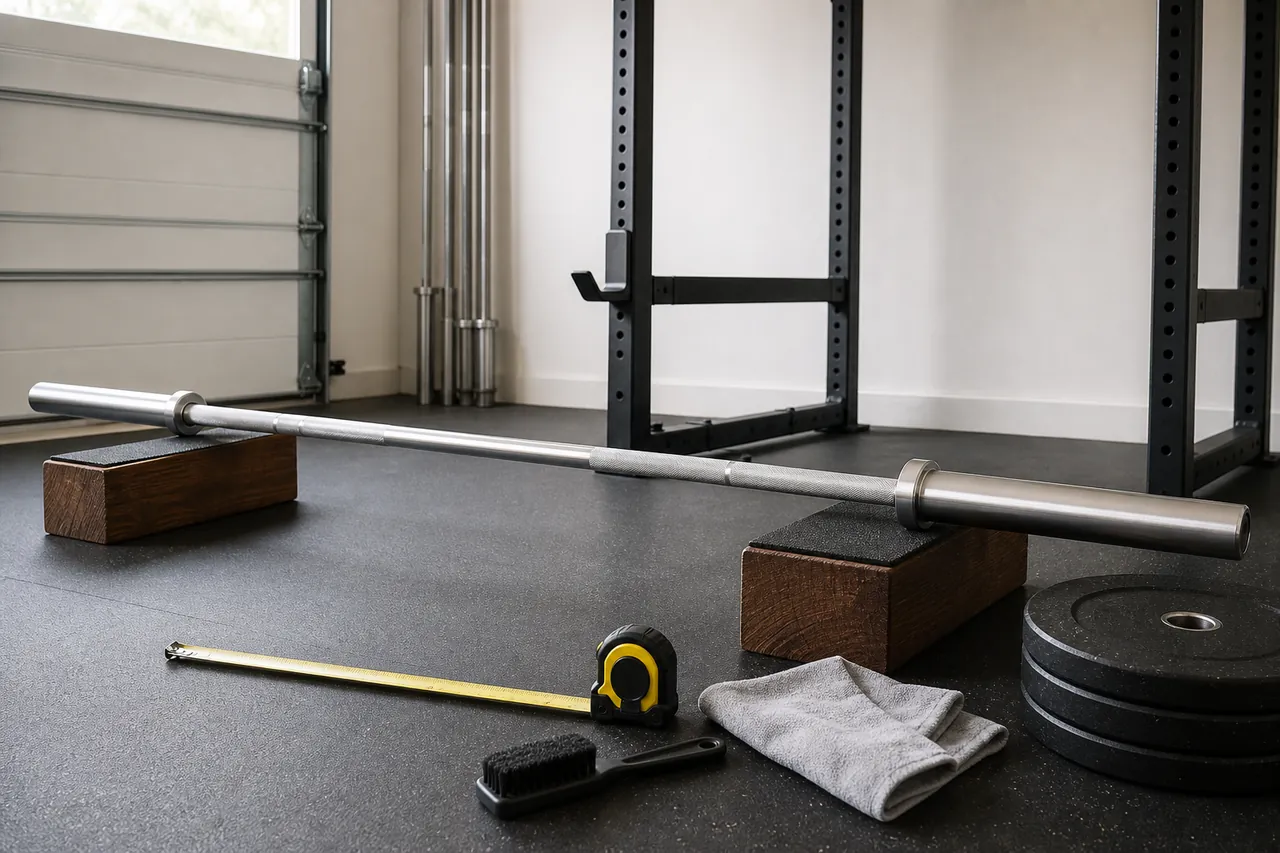
Tape the bar before freight arrives
Run a rack, collar and sleeve rehearsal
- Measure clear J-cup spacing and compare it with the published distance between sleeves. Leave room so collars do not strike the cups during an imperfect rerack.
- On the floor, tape half the bar length from center to end and mark the sleeve start. Confirm walls, doors and plate trees stay clear.
- Stack one side's actual bumper or iron plate widths on a paper line, then add the collar width. Compare the total with 13, 16.1 or 16.25 inches.
- Write where loaded lifts start and end: rack, platform, blocks or floor. Check the bar and plate maker's dropping and surface rules.
Assumptions: published dimensions do not include your collar width, J-cup padding, plate tolerances or bar movement. Add margin; this is a fit screen, not a clearance guarantee.
What the steel numbers cannot tell you
None of these pages proves which knurl your hands will prefer, how a sleeve sounds after a year, whether a coating will survive your J-cups, or how straight the delivered bar is. Inspect the individual bar on arrival and preserve the packaging until it passes the maker's return process.
A lifetime warranty is not permission to drop onto spotter arms, store a wet bar, overload damaged bumpers or skip maintenance. Read the exclusions for the exact region and owner.
Write a first-load passport
Record five items on the bar's first day: empty mass stamped or verified; shaft diameter; plate stack plus collar width per side; finish and cleaning method; warranty proof and serial/order record. Photograph the unloaded shaft rolling on a clean level surface only if the maker recommends that inspection. This separates an arrival defect from later finish wear and stops a 15 kg bar from being logged as 20 kg in shared training.
Barbell dimensions, construction, origin and warranty
Brand location and exact-model manufacture are separate. Warranty summaries are not safe-load ratings.
| Bar | Size and weight | Construction | Manufacturing origin | Brand | Warranty |
|---|---|---|---|---|---|
| REP Colorado Bar 20 kg | 20 kg; 86.6 in; 28.5 mm; 16.1 in sleeves | Steel shaft; composite bushings; dual marks; finish varies by selected variant | Not disclosed for this exact model; ask REP and inspect the bar/endcap. | REP Fitness, Colorado, USA; founding year not verified from the accessible first-party source; home and commercial strength equipment. | Product page states lifetime; confirm finish, corrosion, abuse and commercial-use exclusions by region. |
| Rogue 45LB Ohio Power Bar - Black Zinc | 45 lb; 86.52 in; 29 mm; 16.25 in sleeves | 205,000 PSI steel; bronze bushings; black-zinc shaft; bright-zinc sleeves | Made in USA; manufactured in Columbus, Ohio. | Rogue Fitness, Columbus, Ohio; established 2006; strength and conditioning equipment. | Lifetime against construction and bending; negligent use, alteration, poor care/storage and abusive dropping excluded. |
| The Bella Bar 2.0 - Black Zinc | 15 kg; 79.13 in; 25 mm; 13 in sleeves | 190,000 PSI steel; bronze bushings; black-zinc shaft; bright-zinc sleeves | Made in USA; manufactured in Columbus, Ohio. | Rogue Fitness, Columbus, Ohio; established 2006; strength and conditioning equipment. | Lifetime against construction and bending; negligent use, alteration, poor care/storage and abusive dropping excluded. |
| Rogue 28MM IWF Olympic Weightlifting Bar with Center Knurl - Bright Zinc | 20 kg; 86.6 in; 28 mm; 16.25 in sleeves | 215,000 PSI shaft; 10 needle bearings; friction-welded sleeves; bright zinc | Made in USA with US/EU steel; machined and assembled in Columbus, Ohio. | Rogue Fitness, Columbus, Ohio; established 2006; strength and conditioning equipment. | Lifetime against bending; bad handling/storage and abusive dropping with unsuitable plates or surfaces excluded. |
Inspect the delivered bar before the first loaded session
- Match the exact model, mass, diameter, finish and knurl layout to the order.
- Look for shipping damage, sleeve/endcap issues and corrosion before discarding packaging.
- Confirm plates and collars fit without force and that the rack rehearsal margin remains.
- Read the maker's cleaning, storage and dropping exclusions for the chosen finish.
- Use qualified coaching for lifting technique; product selection is not a safety guarantee.
Sources checked
- REP Colorado Bar 20 kg
- REP warranty terms
- REP company background
- Rogue Ohio Power Bar
- Rogue Bella Bar 2.0
- Rogue IWF 28 mm bar
- Rogue warranty information
- Rogue company background
- Rogue Europe barbell category
- Strength Shop Europe barbell category
- IWF technical rules
- Rogue barbell maintenance guide
- Bells availability-conflict record
- CAP exact-model check