Road trainers checked
Best Running Shoes for Heavy Runners: Fit, Width and Platform Checks
Start with the shoe that matches your foot shape and your current setup, then make it pass a loaded indoor comparison. More foam is not a substitute for heel hold, forefoot room, or predictable turns.
Go to the shoe map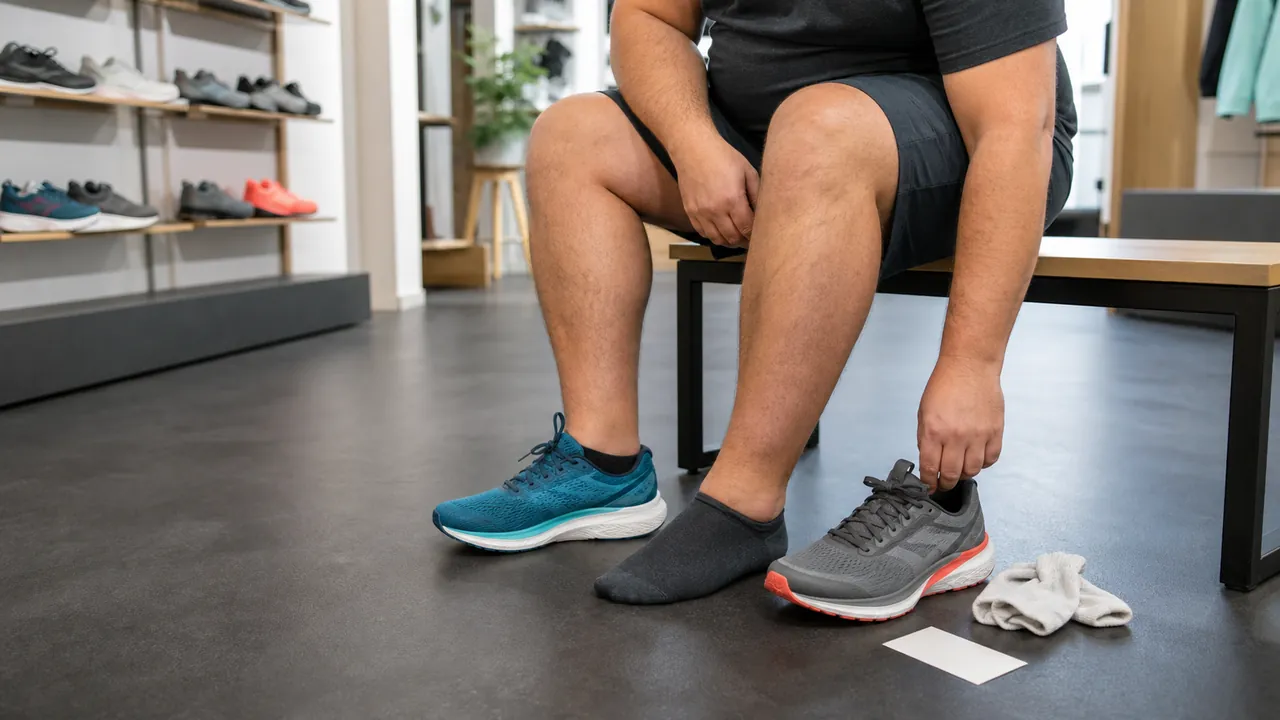
We checked current maker specifications, exact-model order pages, width choices, return or warranty terms, and cross-specialist stock. We did not run in these shoes. Cushioning, comfort, control, durability, and fit still need your own comparison.
Neutral baseline: ASICS GEL-NIMBUS 28.
Guided feel: Brooks Glycerin GTS 23, only if you already prefer it.
Roomy toe shape: Topo Athletic Atmos 2.
Width scale: New Balance 1080v15.
Avoid: choosing “maximum cushion” or “stability” as an injury-prevention promise.
Verify before buying: exact width, heel hold, loaded side pressure, drop change, seller wear rules, and color-specific stock.
Read the box, then test the shoe
Fit language that changes the purchase
A proxy buyer should be able to explain these terms before choosing a model or width.
Heavy runner
Here it means a runner who expects body weight to load the shoe noticeably, not a diagnosis or a fixed number.
The same shoe can hold differently across foot shapes, sizes, pace, and movement.
Judge observable fit while standing, turning, and jogging indoors.
A body-weight cutoff cannot identify one universally suitable shoe.
Stack height
The amount of material between foot and ground at a stated point, usually heel and forefoot.
It changes platform height and geometry, but not comfort by itself.
Compare how the shoe behaves on turns, not only how tall the number looks.
Higher stack does not prove better cushioning, control, or durability.
Heel-to-toe drop
The advertised difference between heel and forefoot height.
This shortlist spans 5 to 8 mm; that may be a noticeable change from an old shoe.
Write down the old model and drop, then change one variable at a time.
Equal drop does not make two shoes feel or fit alike.
Neutral platform
A maker category without the added guidance system used in its structured-support model.
It creates a cleaner baseline when you do not deliberately seek guidance geometry.
Compare it under the same socks, size baseline, and indoor route.
Neutral does not mean structure-free, unstable, or medically correct.
Structured support
A shoe geometry designed to guide movement, such as Brooks GuideRails.
Some runners prefer the sensation; others notice side pressure or intrusion.
Choose it from direct comparison or an established preference, not a label.
It is not gait correction, treatment, or an injury-prevention guarantee.
Width grade and toe-box shape
A width grade such as 2E changes a brand's fit volume; toe-box shape describes the outline around the toes.
A conventional wide and a roomy anatomical toe box solve different pressure patterns.
Try the same length in adjacent widths before buying a longer shoe.
“Wide” is not a universal millimeter standard, and roomy toes do not guarantee a roomy midfoot.
Reference weight
The published weight of one shoe in a maker's reference size when stated.
Your size, width, and production variation change the actual figure.
Use it for broad comparison, then prioritize secure fit and predictable movement.
A lighter shoe is not automatically better for a heavier runner.
Return window
The seller's time and condition rules for returning a shoe.
Outdoor wear may end the cleanest route out of a poor fit.
Read the exact seller policy before the first trial and keep the box.
A manufacturer's direct policy does not automatically cover a specialist-store purchase.
How these made the cut
Current road shoes with different answers to the same load
Each model needed a current maker page, ordinary exact-model ordering in the US and Europe/UK, a direct specialist page in both markets, a distinct buyer lane, and enough construction data to explain the tradeoff. We verified a named color, size, width where shown, and option-specific stock at US and European specialists; those options demonstrate orderability, not the size you should buy.
Cross-store stock, maker category placement, and exact-page review counts show market attention. They do not prove quality, fit, ride, lifespan, or suitability for a body weight. Older generations and racing or trail shoes were removed before recommendations.
Compare the variable you intend to change
Start with shape and transition, not softness
The measurements are published reference values, not project measurements. Use the final column to choose the first side-by-side comparison.
| Exact model | Lane | Drop | Fit control | Start here when... |
|---|---|---|---|---|
| ASICS GEL-NIMBUS 28 | Neutral, maximum cushion | 8 mm | Men's D specialist option verified; exact width stock varies by color. | You want a neutral 8 mm baseline before changing fit shape or guidance. |
| Brooks Glycerin GTS 23 | Structured support / GuideRails | 8 mm | Men's 2E specialist option verified; guidance feel is a deliberate comparison. | You already prefer a guided platform and want to compare it with neutral. |
| Topo Athletic Atmos 2 | Neutral, roomy toe-box shape | 5 mm | Maker shows standard and wide with a roomy toe-box shape. | Forefoot shape is the problem and you can assess a lower-drop change. |
| New Balance 1080v15 | Neutral, broad width scale | 6 mm | Maker shows men's B, D, 2E and 4E; D/2E/4E US 10 stock was checked. | You need to compare B, D, 2E, or 4E before adding shoe length. |
Stack figures are not used as a ranking. Topo publishes 40/35 mm; specialists report 43.5/35.5 mm for ASICS and 40/34 mm for New Balance. Brooks does not publish stack millimeters on the checked maker page.
A shortlist built for comparison
Choose the lane, then let the clean-floor test reject the shoe
Neutral maximum-cushion baseline
ASICS GEL-NIMBUS 28
Begin here when you want a current neutral road trainer with an 8 mm drop and no deliberate move into guidance geometry. That makes it a useful control shoe, not an automatic winner.
What earns the trial: 281 g maker reference, engineered knit upper, current maximum-cushion category, and selected-option stock checks at both specialist anchors.
Main drawback: a tall, soft-feeling neutral shoe can still feel vague or restrictive once your foot loads it; specifications cannot settle that.
Walk away if: the upper presses at the forefoot, the heel lifts, or the platform feels unpredictable on a tight indoor turn.
Closest contrast: New Balance 1080v15 when width choice is the unresolved variable.
What is solid: current identity, construction, drop, reference weight, US/EU order paths, and US warranty. Exact fit and exact-model origin remain unverified.
Guided platform by deliberate preference
Brooks Glycerin GTS 23
The GTS 23 belongs here only for a runner who already likes guidance or can compare it directly with neutral. Its GuideRails geometry is a sensation to evaluate, not a diagnosis in a box.
Useful evidence: 8 mm drop, 311.8 g men's reference, DNA TUNED midsole, selected-option specialist stock, and 188 reviews on the checked men's maker page.
Tradeoff: it is the heaviest published reference here, and rail pressure can be a clear rejection signal.
Skip it if: you are buying “support” because an online label told you to, or if side guidance announces itself during turns.
Compare against: ASICS GEL-NIMBUS 28 at the same 8 mm drop to isolate guidance from drop.
What is solid: model identity, construction, orderability, and active exact-page attention. Warranty duration and exact-model origin were not verified.
Roomy forefoot shape with a lower drop
Topo Athletic Atmos 2
Atmos 2 changes shape more deliberately than a conventional width grade: the toe box is roomy while the heel and midfoot are intended to remain secure. It is the strongest lane when toe spread is the buying problem and a 5 mm drop is an acceptable comparison.
Useful facts: 40/35 mm maker stack, 5 mm drop, 9.9 oz men's US 9 reference, standard and wide controls, and selected-option stock at US and European specialists.
Main drawback: the lower drop and distinctive shape are two changes at once if your old shoe is conventional and high-drop.
Reject it if: the heel or midfoot floats while the toes feel roomy; extra toe space should not require a loose rear fit.
Use instead: New Balance 1080v15 when a familiar width grade is easier to compare.
What is solid: maker geometry, materials, wide option, direct stock, and a US direct 30-day trial. No written defect-warranty duration or exact-model origin was found.
Broad width-scale daily trainer
New Balance 1080v15
Use 1080v15 when you need to compare a conventional men's width run from B to 4E without first adding length. It also has the lightest men's reference here, though that does not decide fit or control.
Useful evidence: 261 g maker reference, 6 mm drop, Infinion midsole, four maker-listed men's widths, and selected-option stock at US and European specialists.
Tradeoff: a printed width does not reveal heel volume, instep pressure, or how the platform feels when loaded.
Do not keep it if: moving up a width creates heel slip, or lacing pressure is needed to control the midfoot.
Different shape: Topo Athletic Atmos 2 when toe-box outline matters more than a standard width code.
What is solid: current construction, width controls, orderability, and return window. A general defect-warranty duration and exact-model origin were not found.
The load changes the answer
Compare the shoe before and after you stand in it
This check records what your foot and the platform do. It does not score gait or predict an injury.
Seated
Loosen the laces, seat the heel, and note toe clearance, side contact, instep pressure, and whether one foot needs a different width.
Standing
Load both feet for a full minute. Reject toe contact, sharp side pressure, upper strain, or a heel that rises as the foot spreads.
Moving
Walk, make two controlled turns each way, and jog only where the seller permits. Record heel lift and platform predictability without calling either “good” from softness alone.
Keep constant: socks, time of day, indoor surface, and lacing method. Compare adjacent widths in the same model before changing length.
Pressure is not always a length problem
Run the width ladder before sizing longer
- Start with measured length. Fit the larger foot and use the maker's current chart only as a starting point.
- Hold length still. Compare the same model in two adjacent widths where stocked. Do not change socks or lacing.
- Read three zones separately. Toes need clearance, midfoot needs secure contact without pressure, and heel needs hold without aggressive lacing.
- Reject the false fix. If extra length removes side pressure but creates heel movement, return to the correct length and change width or shape.
Claims that need a real-world check
What the specifications cannot decide
Soft is not the same as controlled
Step-in softness is immediate; loaded turns and heel hold reveal a different part of the shoe. Neither sensation proves a health outcome.
Support is not a prescription
A guided platform belongs in the shortlist because some runners deliberately prefer it. It is not here to correct pronation or treat pain.
Rubber coverage is not a lifespan
Outsole materials are construction facts. Your size, route, surface, and movement prevent an honest mileage promise from these sources.
Fit is individual
Stop the trial for pain, persistent numbness, or a suspected injury. A qualified professional should handle medical concerns; a buying guide should not.
Make a failed trial explain itself
Change one shoe variable at a time
If width, drop, and guidance all change together, the comparison cannot tell you which variable caused the rejection. Preserve the return path and simplify the next trial.
Facts to check before checkout
Fit controls, construction, origin and written support
Selected sizes below are stock demonstrations, not recommendations. Use the maker or seller's current chart for your foot; retailer-labelled regional pairs are quoted as-is, and no conversions are inferred. Brand history is context, not a quality score.
| Shoe | Fit and selected-stock check | Construction | Manufacturing origin | Brand | Written support |
|---|---|---|---|---|---|
| ASICS GEL-NIMBUS 28 | Men's D option. Grey Blue/Black, US 10 D: US specialist showed 4+ in stock. Black/Cobalt Burst, US 10: European specialist showed 1 in stock. Recheck the current chart and your exact color/size. | Engineered knit; FF BLAST PLUS; PureGEL; HYBRID ASICSGRIP/AHARPLUS rubber. | Not disclosed for this exact model; check the tongue label. Kobe headquarters is not proof of manufacture. | Kobe, Japan; founded 1949; sporting goods and performance running footwear. | US original purchaser: one-year manufacturing-defect warranty; authorized seller and proof required; normal wear and improper fit excluded. |
| Brooks Glycerin GTS 23 | Guided GuideRails construction. Black/Grey/White, US 10 2E: US specialist showed 1 in stock. The European specialist's exact page showed EU 44.5 / US 10.5 with 1 in stock; that pairing is the retailer's label. | Triple-jacquard warp knit; DNA TUNED midsole; GuideRails geometry; rubber outsole. | Not disclosed for this exact model; check the tongue label. Seattle headquarters is not proof of manufacture. | Seattle, US; roots in 1914; performance running footwear and apparel. | Workmanship/material support is published, but a duration was not verified. Brooks-direct returns and specialist-store terms differ. |
| Topo Athletic Atmos 2 | Roomy toe box with secure midfoot/heel intent; maker shows standard and wide. Grey/Grey, US 10 D: US specialist showed 1 in stock. Navy/Orange, US 10: European specialist showed 1 in stock. | Recycled engineered mesh; ZipFoam; OrthoLite footbed; strategic rubber zones. | Not disclosed for this exact model; check the tongue label. Framingham office is not proof of manufacture. | Framingham, US; launched 2013; running and hiking shoes with roomy toe boxes and lower drops. | US direct purchases: 30-day worn trial. No current written defect-warranty duration found; request seller terms. |
| New Balance 1080v15 | Maker lists men's B, D, 2E and 4E. Black/Grey/Black, US 10: US specialist showed D (1), 2E (2), and 4E (1) in stock. European specialist showed Afterglow/Blue Bird/Silver Metallic, EU 44 / US 10, with 1 in stock; the pairing is retailer-labelled. | Perforated mesh; Infinion midsole; rubber outsole; men's B, D, 2E and 4E controls. | Not disclosed for this exact model. Boston headquarters and separate Made ranges are not proof of 1080v15 manufacture. | Boston, US; founded 1906; athletic footwear and apparel with broad size/width programs. | US direct returns: 45 days in qualifying condition. No general running-shoe defect-warranty duration found; ask the seller. |
Open the exact model, not a search result
Sources checked
Availability changes by color, size, width, and market. The named stock examples are verification snapshots from July 19, 2026; recheck your exact option before paying.
ASICS
Brooks
Topo Athletic
Final buying action: bring the old shoes and usual socks, compare one variable at a time, and keep the new pair indoors until heel, width, drop, and turns all make sense.
Found a changed specification, unavailable model, or factual error? Email the Garage Gym Power editors so the claim can be rechecked.